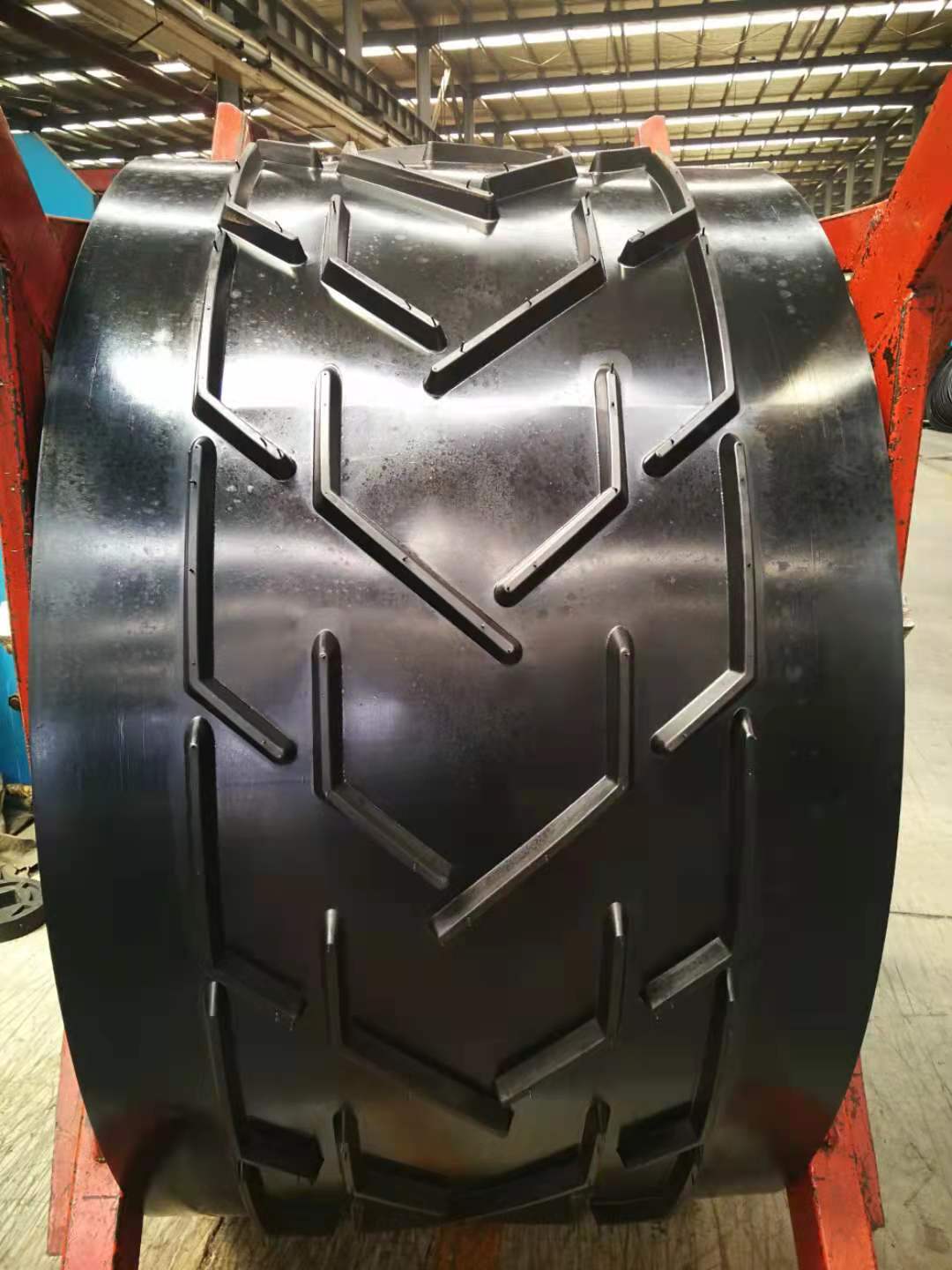
A chevron rubber conveyor belt is specifically designed for transporting bulk materials on steep conveyor systems where standard flat belts may struggle. In industries such as mining, aggregates, and sand handling, materials can easily slide backward on inclined conveyors, causing production delays and increasing equipment wear. Continuous material rollback not only reduces efficiency but can also create safety hazards and additional cleanup work. By installing a well-designed chevron rubber conveyor belt with molded cleats, materials remain securely in place during transport. Selecting the appropriate chevron rubber conveyor belt based on incline angle, material type, and moisture conditions helps ensure smooth conveying, improved productivity, and long-term operational reliability.
What is a chevron rubber conveyor belt?
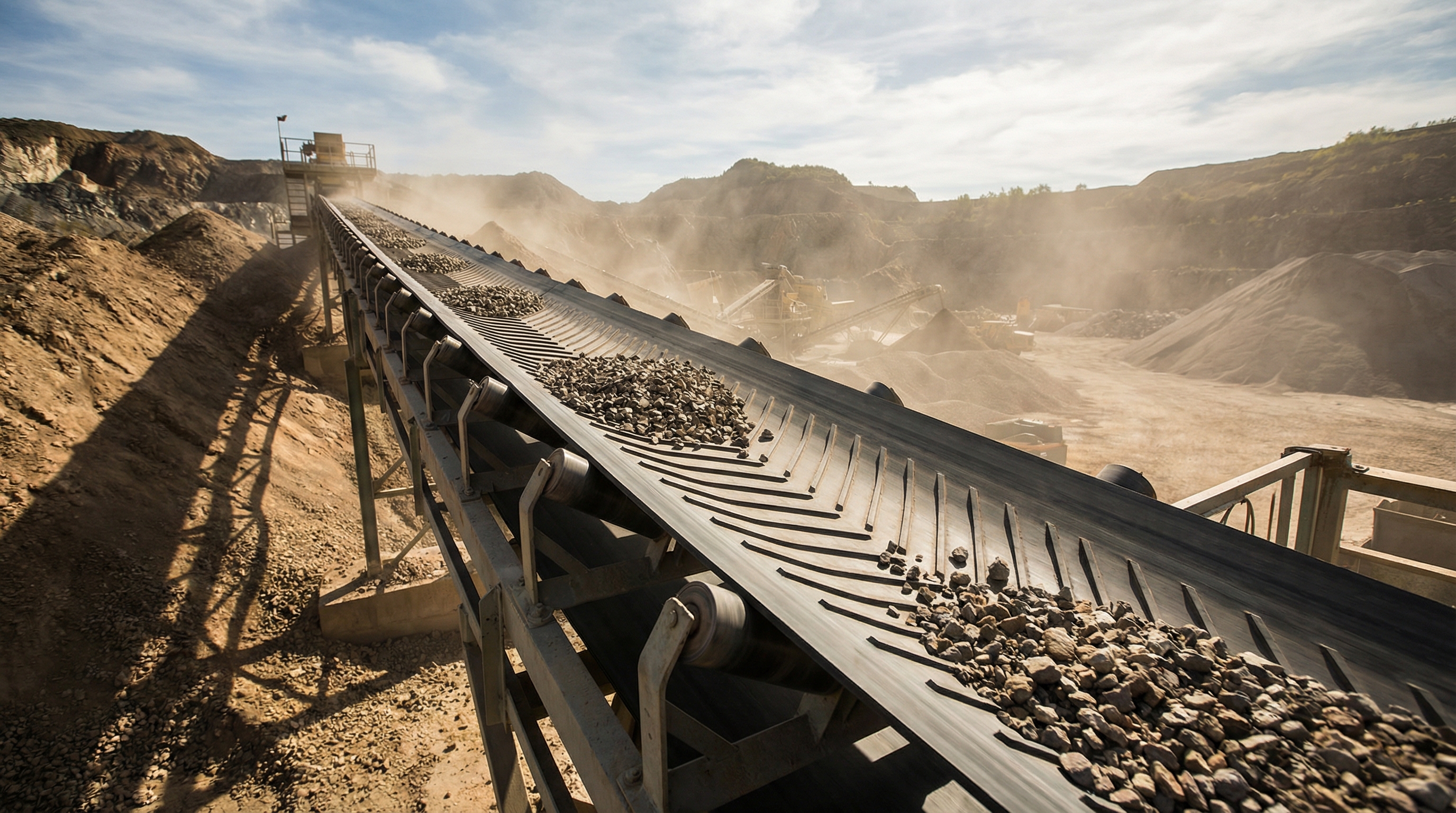
A chevron rubber conveyor belt is a heavyweight transport medium equipped with integrally molded, raised cleats on the top cover to prevent material slippage. These belts are specifically engineered for bulk handling applications where gravity would otherwise cause materials to roll back on an incline.
You will find that these belts utilize high-tensile rubber compounds like SBR or Grade 1 for maximum durability. Unlike a standard Fabric (Textile) Conveyor Belt , the surface is not flat but features a distinct profile pattern.
Do molded cleats improve grip?
Molded cleats are essential because they provide the mechanical “pockets” needed to trap loose materials during vertical or semi-vertical movement. Here is the kicker: because these cleats are vulcanized directly onto the base belt, they offer far superior strength compared to cold-bonded alternatives.
- Cleats range from 1/4″ to 2″ in height.
- Available in over 150 unique patterns.
- Designed for angles up to 35 degrees.
Key Takeaway: A chevron rubber conveyor belt is your primary defense against product rollback, providing the necessary mechanical friction that standard textile belts cannot offer.
| Component | Standard Specification | |
|---|---|---|
| Material Base | High-tensile EP Fabric | |
| Cleat Style | Integrally Molded Chevron | |
| Rubber Grade | SBR or Grade 1 Compounds |
Analyzing the integration of these cleats shows that molded construction is the only way to ensure the belt survives high-impact loading zones.
How does a chevron rubber conveyor belt work?

A chevron rubber conveyor belt works by using its profiled surface to create a high coefficient of friction between the belt and the bulk material. As the belt moves up a slope, the cleats act as physical barriers that stop sand, gravel, or grain from sliding downward.
This design ensures that your material stays at the same relative position on the belt from the loading point to the discharge area. You can effectively increase the angle of your conveyor system without sacrificing the volume of material moved per hour.
How do nested patterns help?
Nested configurations are critical for maintaining a smooth operation when the belt returns over the bottom idlers. You should know that overlapping cleats ensure the belt is always in contact with the return rollers, preventing the “bouncing” effect that destroys equipment.
Think about it this way:
- Overlapping cleats create a constant contact plane.
- Constant contact reduces vibration and noise.
- Smooth transitions prolong the life of the belt carcass.
Key Takeaway: The mechanical geometry of a chevron rubber conveyor belt transforms gravity from a hindrance into a manageable factor by trapping material in stable pockets.
| Function | Operational Benefit | |
|---|---|---|
| Mechanical Grip | Prevents gravity-induced sliding | |
| Pattern Overlap | Ensures smooth return idler contact | |
| Friction Pockets | Stabilizes loose or wet bulk goods |
This operational synergy between the profile shape and the idler configuration is what keeps your throughput consistent.
Why use a chevron rubber conveyor belt for inclines?
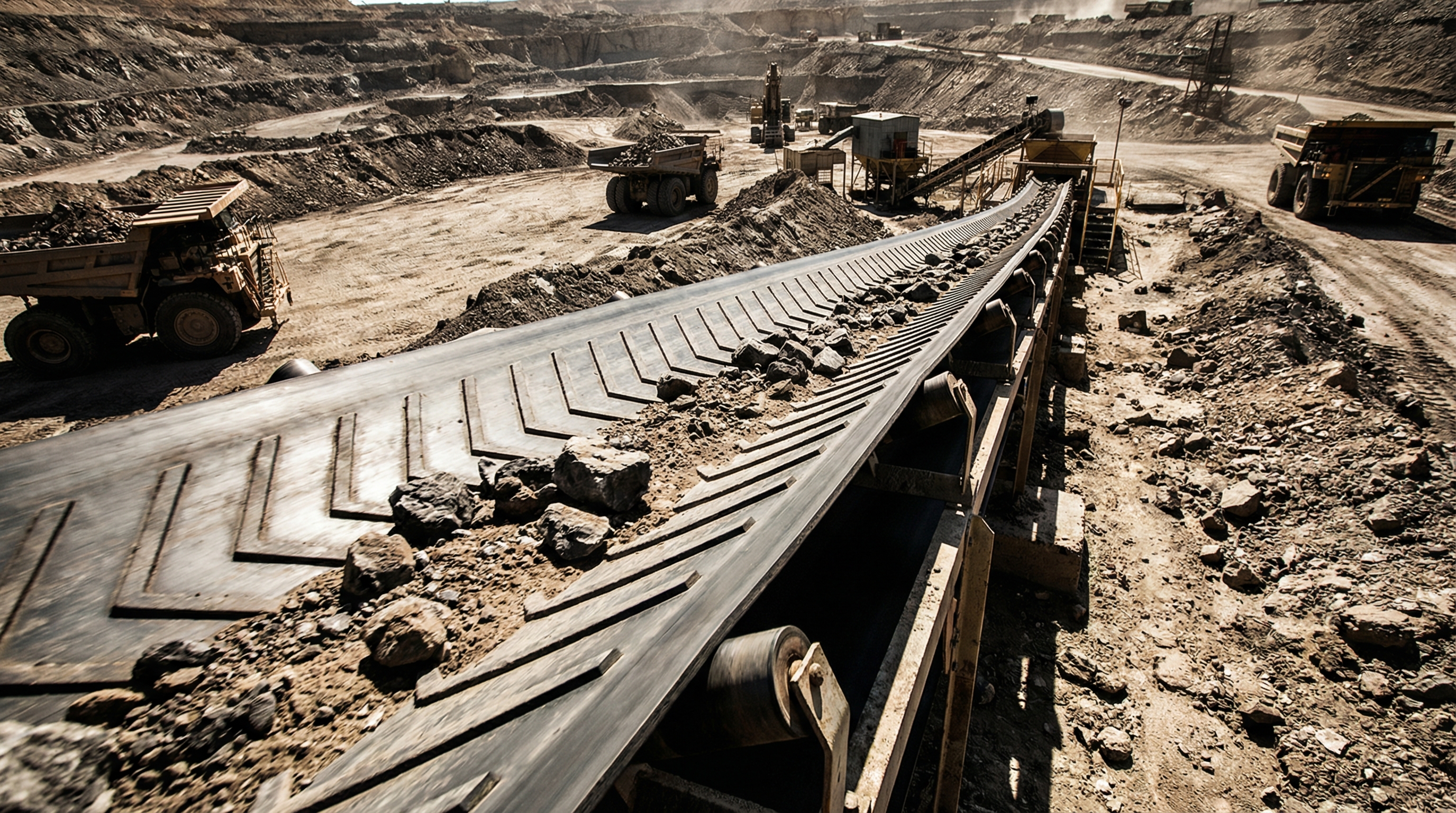
You choose a chevron rubber conveyor belt for inclines because standard flat belts lose their carrying efficiency once the slope exceeds 15 degrees. For steep logistics between 15° and 35°, the cleated surface is the only way to maintain a safe and productive flow.
While a high-tension Steel Cord Conveyor Belt is great for long horizontal distances, it lacks the surface profile needed for steep verticality. Chevron patterns bridge this gap by providing vertical stability for loose aggregates.
Is rollback prevention guaranteed?
Rollback prevention is significantly enhanced when you match the specific cleat height to your material’s lump size. It is worth noting that using the wrong profile can actually lead to material buildup and belt tracking issues.
- 15° to 22°: Use shallow cleats (approx 1/2″).
- 23° to 35°: Use deep cleats (1″ or higher).
- Over 35°: Consider sidewall solutions.
Key Takeaway: Selecting a chevron rubber conveyor belt for your incline allows you to maximize your facility’s vertical space without losing product to slippage.
| Incline Degree | Recommended Surface | |
|---|---|---|
| 0° – 15° | Standard Flat Top | |
| 15° – 35° | Chevron Profiled Cleats | |
| 35°+ | High Sidewall & Cross-Cleats |
The transition from flat to cleated surfaces is the most cost-effective way to increase your plant’s storage capacity via vertical stockpiling.
Which industries need a chevron rubber conveyor belt?

The primary industries that rely on a chevron rubber conveyor belt include mining, aggregate production, and large-scale recycling operations. You will often see these belts in tub grinders and mobile screening plants where space is limited and angles are aggressive.
Agriculture also benefits heavily from these belts when moving grain or seeds into silos at steep angles. The versatility of the rubber compounds allows these industries to handle everything from wet sand to sharp rocks without tearing.
Why is aggregate mining a top user?
Aggregate sites require these belts because they deal with diverse material sizes and moisture levels that vary daily. But wait, there’s more: these belts are also critical for port terminals where rapid ship loading requires steep discharge inclines.
- Mining: Iron ore, coal, and limestone transport.
- Recycling: Moving waste through sorting towers.
- Construction: Sand and gravel for concrete batch plants.
Key Takeaway: Any industry requiring the movement of bulk materials up a slope of more than 15 degrees must utilize a chevron rubber conveyor belt to ensure efficiency.
| Sector | Typical Material | |
|---|---|---|
| Recycling | Mixed waste, crushed glass | |
| Mining | Crushed stone, minerals | |
| Agriculture | Corn, wheat, fertilizer |
Identifying your specific industry needs allows for the selection of the correct rubber cover grade, such as abrasion or oil resistance.
What are common chevron rubber conveyor belt designs?
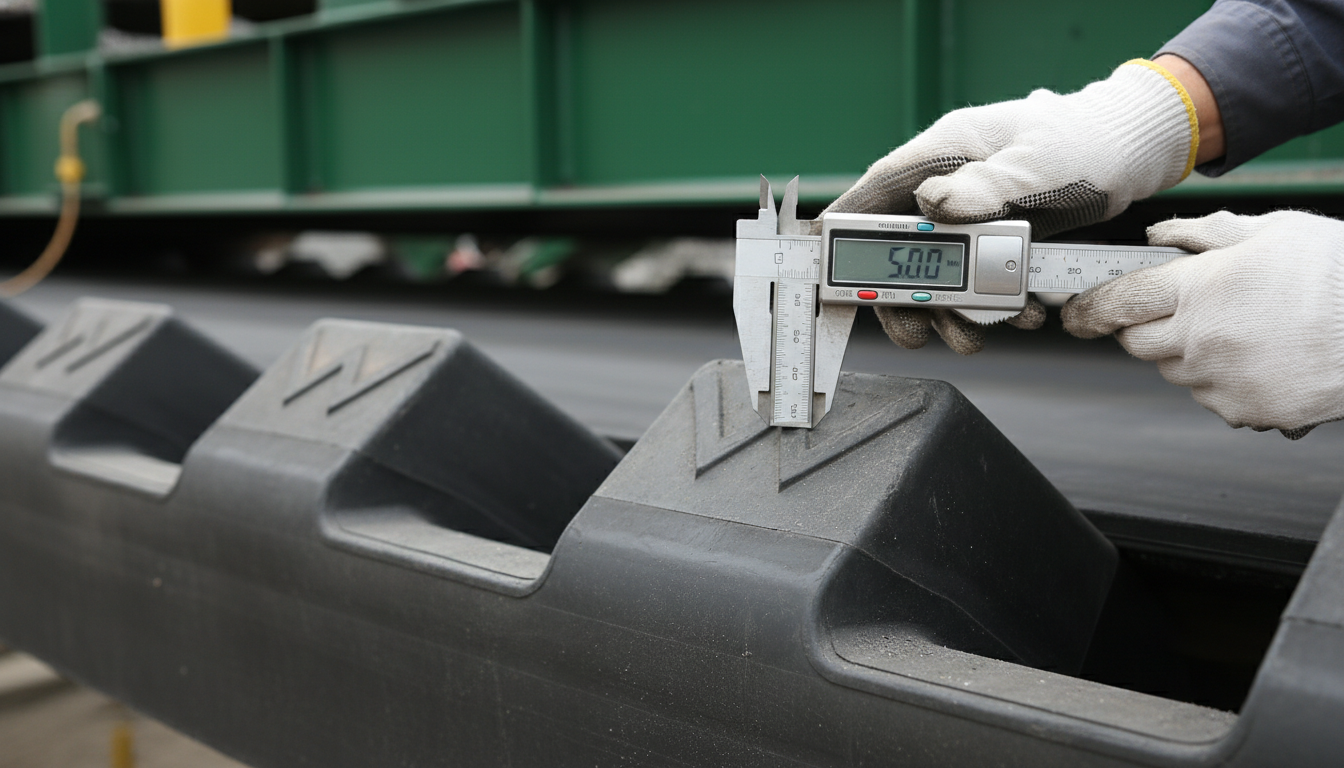
The most popular designs for a chevron rubber conveyor belt are the Open-V and Closed-V patterns. You must choose based on your material’s drainage needs, as the Open-V style allows liquids to run off the sides while the Closed-V traps them.
Other specialized designs include herringbone and U-shaped cleats, which are often used for smaller particles. These patterns ensure that even “fines” or dust-like materials stay on the belt during the ascent.
When to use Open-V versus Closed-V?
Open-V is the standard for wet materials like washed sand where you need water to exit the belt before it reaches the discharge point. The truth is, using a Closed-V pattern for wet materials can lead to “slurring,” where the material slides in its own liquid.
- Open-V: Best for drainage and moisture control.
- Closed-V: Best for dry powders and light bulk.
- U-Shape: Best for very small particles on narrow belts.
Key Takeaway: Choosing the right pattern for your chevron rubber conveyor belt is not just about grip; it is about managing the moisture and size of your specific cargo.
| Pattern Type | Best Application | |
|---|---|---|
| Open-V | Wet sand, gravel, aggregates | |
| Closed-V | Dry grain, coal, wood chips | |
| Herringbone | Large, non-uniform minerals |
Matching the pattern to the material flow characteristics prevents clogs and ensures the belt stays balanced on the rollers.
How to choose a chevron rubber conveyor belt height?

You should determine your chevron rubber conveyor belt cleat height based on the maximum lump size of your material and the steepness of the incline. Standard heights typically range from 1/4 inch for small grains up to 2 inches for large, heavy rocks.
If your incline exceeds 35 degrees, you might need to look past standard chevron heights and consider a specialized Sidewall Conveyor Belt . However, for most industrial inclines, a 1-inch cleat provides the perfect balance of grip and flexibility.
Does material size dictate cleat height?
Material size is the most important factor because the cleat must be high enough to “catch” the largest pieces in your flow. Here is the kicker: if the cleat is too short, the material will simply tumble over the top and roll down the belt.
- Small Fines: 1/4″ to 1/2″ cleats.
- Medium Aggregate: 3/4″ to 1-1/2″ cleats.
- Large Rocks: 2″ reinforced cleats.
Key Takeaway: The height of your chevron rubber conveyor belt cleats must be roughly 50% to 100% of your largest material lump to effectively stop rollback.
| Lump Size | Recommended Cleat Height | |
|---|---|---|
| < 1/2 inch | 1/2 inch cleat | |
| 1 – 2 inches | 1 inch cleat | |
| > 3 inches | 1-1/2 to 2 inch cleat |
Proper height selection ensures that the belt remains easy to clean while still providing the maximum mechanical advantage for the climb.
Is a chevron rubber conveyor belt chemical resistant?
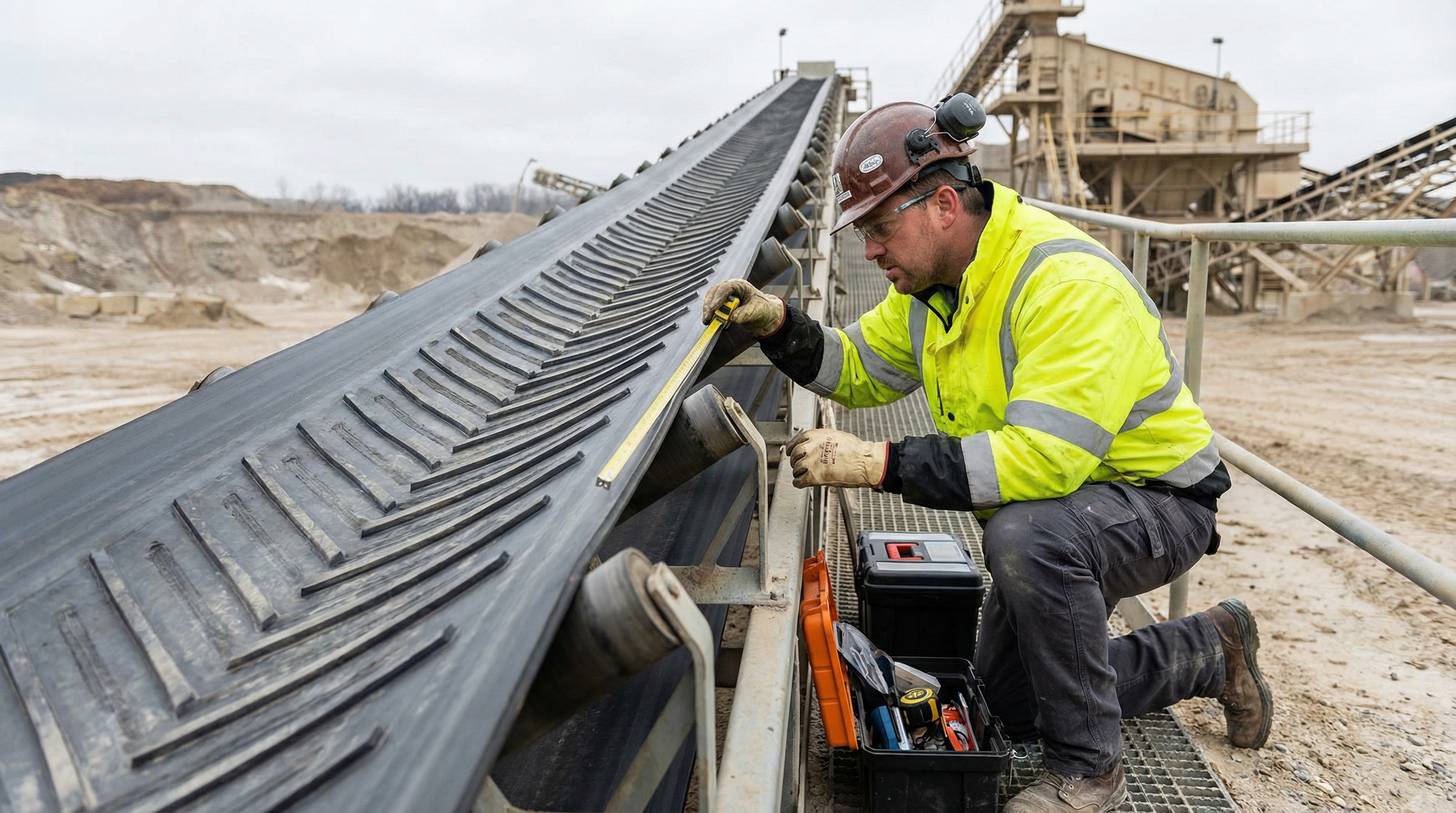
Yes, a chevron rubber conveyor belt can be manufactured with specialized compounds that resist oils, chemicals, and high temperatures. You must specify your environmental conditions to ensure the rubber cover doesn’t swell or crack when exposed to harsh substances.
Grade 1 rubber is often used for high-tensile strength, while nitrile-based compounds are ideal for oily recycled waste. These materials ensure that the cleats maintain their shape and integrity even in punishing chemical environments.
Can it handle hot aggregates?
Heat resistance is available for sectors like cement or asphalt where materials are conveyed at temperatures exceeding 200°C. You will find that these specialized belts use EPDM or heat-tolerant SBR to prevent the cleat from melting or detaching.
Think about this:
- Oil-resistant belts prevent “cupping” and swelling.
- Heat-resistant belts maintain cleat stiffness.
- Chemical-resistant belts resist acidic leaching.
Key Takeaway: Customizing the compound of your chevron rubber conveyor belt ensures that chemical exposure does not lead to premature cleat failure or carcass degradation.
| Resistance Type | Best For | |
|---|---|---|
| Oil Resistant | Recycling, fertilizer, food waste | |
| Heat Resistant | Cement clinker, hot asphalt | |
| High Abrasion | Granite, quartz, sharp mining ore |
Selecting the right cover grade is as important as the cleat design for long-term return on investment in chemical-heavy plants.
How to maintain a chevron rubber conveyor belt daily?

To maintain your chevron rubber conveyor belt, you must perform daily visual inspections for cleat wear and carcass damage. Because the cleats are raised, they are more susceptible to being ripped off if high-impact materials are loaded incorrectly.
You should also check the belt tracking to ensure it isn’t rubbing against the conveyor frame, which can shave off the cleat edges. For very light-duty applications, you might even consider a Rough Top Conveyor Belt if your maintenance budget is extremely tight.
How to ensure proper tracking?
Tracking is managed by adjusting the idlers and ensuring the belt is loaded centrally. It goes without saying that a belt that is constantly off-center will experience uneven cleat wear, eventually leading to material spillage.
- Clean out trapped fines between cleats.
- Inspect the vulcanized bond for lifting.
- Check return idlers for material buildup.
Key Takeaway: Daily maintenance of your chevron rubber conveyor belt prevents small cleat tears from becoming catastrophic belt failures that stop production.
| Maintenance Task | Frequency | |
|---|---|---|
| Visual Cleat Check | Every shift | |
| Tracking Alignment | Weekly | |
| Idler Cleaning | Daily |
Daily vigilance keeps your system quiet and efficient while protecting the expensive internal fabric reinforcement from exposure.
Can a chevron rubber conveyor belt stop spillage?

A chevron rubber conveyor belt is highly effective at stopping spillage, provided that the cleats are indented from the belt edges. You need this indentation to allow room for skirtboard rubber to create a seal, directing material toward the center.
Many factory-molded belts have cleats that go all the way to the edge, which makes it impossible to seal the loading zone. By choosing a custom design with recessed cleats, you eliminate the “housecleaning” issues that plague many aggregate facilities.
Does skirtboard placement matter?
Skirtboard placement is the secret to a clean operation because it keeps the material contained until it stabilizes on the moving belt. You will find that without proper skirting, fines will escape from the sides of even the best cleated belt.
- Indented cleats provide a flat sealing surface.
- Skirtboards direct material to the belt center.
- Nested patterns reduce the vibration that causes dust.
Key Takeaway: The anti-spillage capability of a chevron rubber conveyor belt depends on a design that accommodates peripheral sealing components like rubber skirting.
| Spillage Feature | Operational Impact | |
|---|---|---|
| Indented Cleats | Allows for perfect skirtboard sealing | |
| Nested Profile | Reduces bouncing and dust generation | |
| V-Shape Design | Centrally locates material during travel |
Optimizing the loading zone with a cleated belt can reduce your cleanup labor costs by more than 50% over the life of the belt.
Where to order a chevron rubber conveyor belt online?

You should order your chevron rubber conveyor belt directly from a manufacturer that offers customization and technical consultation. Buying from a direct factory ensures you get the exact pattern and rubber compound needed for your specific moisture and lump size.
Look for a supplier that provides over 150 pattern options and stable lead times. By working with experts who understand the engineering behind cleat heights and nested configurations, you guarantee a solution that works on your existing idlers.
Is a direct factory better?
Direct factories offer significant cost savings of 15% to 30% because they eliminate middleman markups. The bottom line is: you get better quality control and faster technical support when you deal with the people who actually mold the rubber.
- Request a drawing-based quotation.
- Look for CE and ISO certifications.
- Ask for samples of different cleat heights.
Key Takeaway: Purchasing your chevron rubber conveyor belt from a specialized manufacturer ensures you receive a high-performance product tailored to your incline challenges.
| Buying Choice | Advantage | |
|---|---|---|
| Direct Factory | 15-30% savings and technical depth | |
| Custom Patterns | Perfect fit for specific material types | |
| Global Export | Proven performance in harsh environments |
Taking the time to consult with an engineer before your purchase prevents the common mistake of ordering a generic belt for a specialized task.
Conclusion
Navigating the complexities of steep material handling requires more than just a standard belt; it requires a precision-engineered chevron rubber conveyor belt. By selecting the right cleat height, pattern design, and rubber compound, you solve the persistent problems of product rollback, hazardous spillage, and operational downtime. Our vision is to provide every industrial site with the most durable and efficient conveying solutions available. Whether you are in mining, recycling, or agriculture, a custom cleated belt is the key to unlocking higher throughput and lower maintenance costs.
Contact us today to receive a custom technical solution and an accurate quotation for your next high-performance conveyor system.
Frequently Asked Questions
What is the maximum incline for a chevron rubber conveyor belt?Most systems handle 15 to 35 degrees efficiently. The actual limit depends on the material’s moisture content and the specific height of the cleats you select for your application.
Can I use these belts on my existing flat idlers?Yes. These belts are designed to operate on traditional troughing idlers, flat idlers, and even metal beds or pans, making them easy to retrofit into your current system.
What is the best way to prevent belt bouncing on the return?The best way is to choose a “nested” cleat configuration. This ensures that the cleats are in constant contact with the return idlers, providing a smooth transition and reducing mechanical vibration.
Can I get a chevron belt that is resistant to oil and heat?Yes. Manufacturers offer specialized cover grades like Grade 1, oil-resistant nitrile, and heat-resistant EPDM to ensure your belt survives in punishing industrial or recycling environments.
Why should cleats be indented from the belt edges?Indenting allows you to install skirtboard rubber along the edges of the belt. This creates a tight seal that prevents material from spilling over the sides at the loading point.