
Aggregate Conveyor Belt Solutions for Quarry & Construction Plants
Key Conveyor Belt Challenges in Aggregate Operations
Aggregate plants and quarry operations place extreme stress on conveyor belts. Heavy impact, sharp materials, and abrasive dust can quickly cause belt wear, damage, and costly production downtime. Understanding these challenges allows us to engineer heavy-duty conveyor belt solutions that improve durability, reduce maintenance, and ensure continuous material handling in demanding environments.
Heavy Impact Damage
Large rocks and heavy aggregate materials create strong impact at loading points. Without proper impact-resistant conveyor belts, belt covers and carcasses can suffer premature damage and reduced service life..
Severe Abrasion Wear
Sharp gravel, crushed stone, and sand continuously rub against the belt surface. This abrasive material wear quickly reduces rubber cover thickness and shortens the lifespan of conveyor belts in aggregate plants..
Dust and Harsh Quarry Environments
Quarry operations expose conveyor systems to dust, moisture, UV radiation, and temperature changes. These conditions accelerate rubber conveyor belt aging and material degradation..
Unexpected Conveyor Belt Downtime
Conveyor belt failures can stop the entire aggregate production line. This results in lost production time, emergency maintenance costs, and delayed material processing..
Advanced Rubber Conveyor Belt Technology for Aggregate and Quarry Applications
Our rubber conveyor belts are engineered with specialized rubber compounds and reinforced belt structures to handle heavy impact, abrasive materials, and continuous operation in quarry and aggregate processing plants. Designed for durability and reliability, our belts help reduce wear, minimize maintenance, and ensure efficient bulk material handling in demanding industrial environments.
Precision-Engineered Rubber Conveyor Belts for Maximum Durability
Our rubber conveyor belts are engineered with advanced rubber compounds and reinforced carcass structures to withstand heavy impact, abrasive materials, and continuous operation in quarry and aggregate environments.
The multi-layer belt construction distributes load stress evenly while maintaining flexibility, ensuring long service life and stable performance in demanding bulk material handling systems.
From raw material selection to final inspection, every belt is produced under strict quality control standards to guarantee reliable performance in mining, quarry, and aggregate processing plants.
Custom Rubber Compound Solutions: WWe develop custom rubber conveyor belt compounds tailored to different operating conditions, including high abrasion resistance, impact resistance, oil resistance, and high-temperature tolerance for demanding industrial applications.
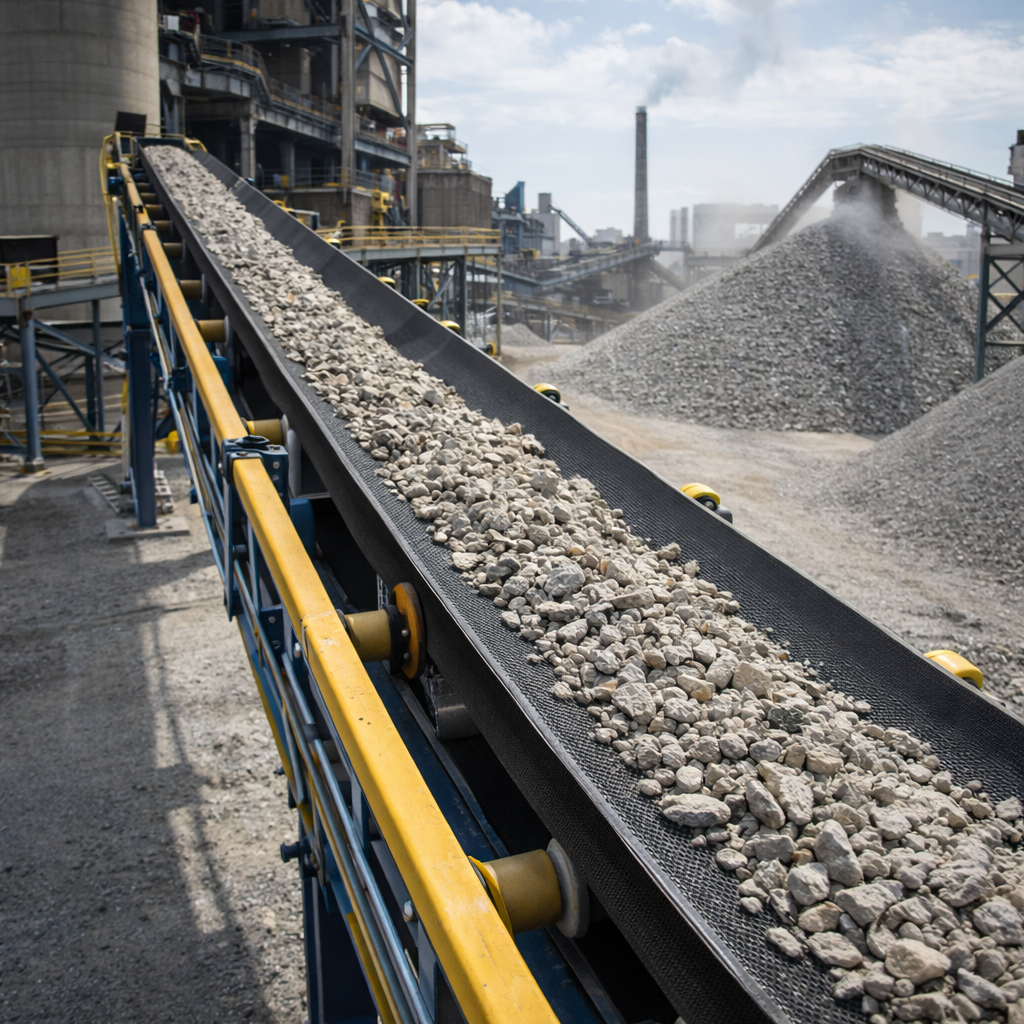
Superior Wear Resistance
Advanced rubber compounds deliver up to 3x longer service life compared to standard belts, reducing replacement frequency and lowering total ownership costs significantly.
Enhanced Shock Absorption
Multi-ply construction with impact-resistant layers protects against damage from falling rocks and heavy aggregate loads, maintaining structural integrity throughout operation.
Anti-Tear Technology
Reinforced fabric layers and specialized rubber formulations prevent rip propagation, ensuring minor damage doesn't compromise entire belt sections during operation.
Extreme Climate Performance
Engineered rubber compounds maintain flexibility in cold conditions and resist degradation in high-heat environments, ensuring consistent performance year-round.
| Rubber Type | Primary Benefits | Ideal Applications | Temperature Range |
|---|---|---|---|
| SBR (Styrene-Butadiene) | Excellent abrasion resistance, cost-effective, versatile performance | General aggregate transport, crushed stone, sand handling | -30°C to +80°C |
| NBR (Nitrile) | Superior oil and grease resistance, chemical stability | Asphalt plants, recycling operations with contaminants | -25°C to +100°C |
| CR (Chloroprene) | Fire resistance, excellent weather resistance, ozone protection | Outdoor quarries, high-temperature environments | -30°C to +90°C |
| EPDM (Ethylene Propylene) | Outstanding heat and weather resistance, UV stability | Hot material transport, extreme outdoor exposure | -40°C to +120°C |
Select the optimal rubber compound for your specific operating conditions
Consult Our EngineersRubber Conveyor Belt Solutions for Quarry and Aggregate Applications
Explore our range of heavy-duty rubber conveyor belts designed for quarry, mining, and aggregate processing plants. Each belt type is engineered to handle abrasive materials, heavy loads, and demanding industrial environments.

Abrasion-Resistant Rubber Conveyor Belt
Designed for sand, gravel, and crushed stone transport, this abrasion-resistant conveyor belt provides excellent resistance against sharp aggregates and continuous material friction. Ideal for quarry operations and aggregate processing plants requiring long belt service life.

Impact-Resistant Conveyor Belt
Built with reinforced carcass layers and shock-absorbing rubber covers, this impact-resistant conveyor belt protects against heavy rock drops at loading points. Perfect for primary crushing zones and high-impact aggregate handling areas.
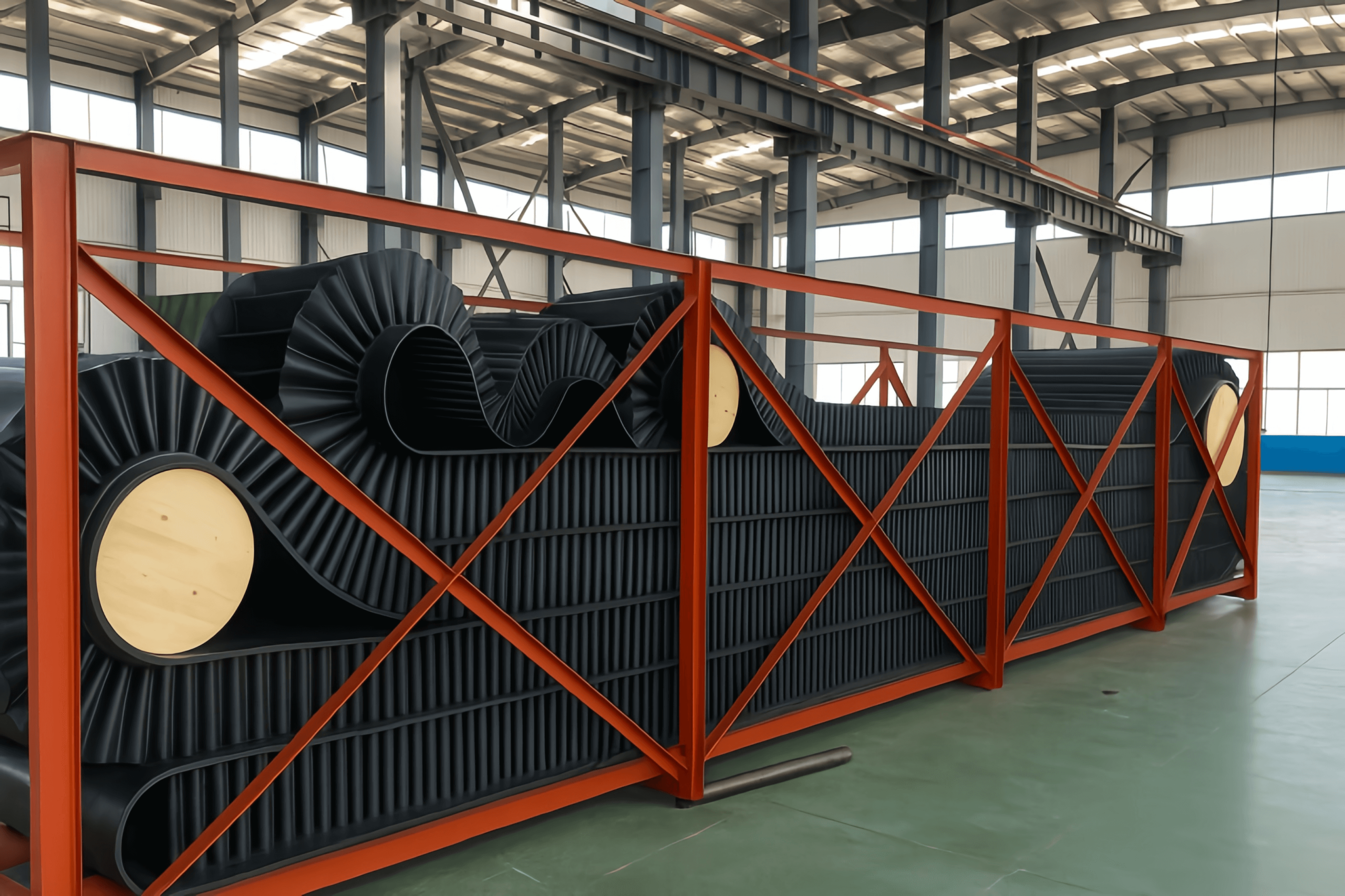
Corrugated Sidewall Conveyor Belt
The sidewall conveyor belt is designed for steep incline conveying and vertical lifting of bulk materials. High sidewalls and cleats prevent material rollback, making it ideal for confined quarry plants and aggregate stockpile transport.

Steel Cord Reinforced Conveyor Belt
Our steel cord reinforced conveyor belt offers superior tensile strength and minimal elongation for long-distance and high-capacity aggregate transport. Recommended for heavy-duty quarry conveyor systems and mining operations.
Find the perfect belt configuration for your material handling needs
View Full SpecificationsRubber Conveyor Belt Applications in Quarry and Aggregate Plants
Our rubber conveyor belts are widely used in quarry and aggregate plants for sand and gravel processing, quarry stone transport, crushing and screening lines, and stockpile distribution. They are engineered to handle abrasive materials, heavy loads, and continuous bulk material conveying.

Sand & Gravel Processing
Our abrasion-resistant rubber conveyor belts transport washed sand and gravel through screening, washing, and processing stages. They help maintain stable performance in wet, high-volume aggregate handling environments.

Quarry Stone Transport
Heavy-duty quarry conveyor belts move blasted rock and crushed stone from extraction points to crushers and transfer stations. Reinforced belt structures help resist impact, tearing, and sharp aggregate materials.

Crushing & Screening Lines
Our rubber conveyor belts connect crushers, screens, and transfer points in aggregate plants. They are designed for continuous material flow, high throughput, and reliable performance in demanding crushing and screening operations.

Stockpile & Distribution
Durable aggregate conveyor belts move finished materials to stockpiles, silos, and truck loading stations. They help reduce spillage, improve transfer efficiency, and support smooth bulk material distribution.
See how our belts integrate seamlessly into your operation workflow
Request Application AnalysisEngineered Approaches for Specific Operating Conditions
We analyze your unique operational challenges and design tailored conveyor solutions that maximize efficiency, minimize downtime, and reduce total cost of ownership.
High-Impact Environment Solutions
Specialized belt construction absorbs repetitive shock loads from heavy falling materials while maintaining structural integrity and operational efficiency.
- Reinforced impact layers with energy-absorbing rubber compounds
- Strategic carcass design distributes stress across belt width
- Extended cover gauge protects against puncture and penetration
- Load zone optimization reduces peak impact forces
Dust & Sticky Material Solutions
Advanced surface treatments and belt designs prevent material adhesion, reduce cleaning requirements, and maintain consistent material flow.
- Anti-stick rubber formulations repel wet and clay materials
- Textured cover patterns facilitate self-cleaning action
- Sealed belt edges prevent dust infiltration and damage
- Moisture-resistant construction maintains performance in wet conditions
Extreme Temperature Solutions
Temperature-specific rubber compounds ensure reliable operation from arctic cold to intense heat, maintaining flexibility and strength.
- Heat-resistant rubber compounds withstand up to 180°C
- Cold-resistant formulations remain flexible at -40°C
- Fire-retardant options meet strict safety standards
- Thermal stability prevents accelerated aging and cracking
Let our engineering team design the optimal solution for your operation
Schedule Engineering ConsultationEssential Conveyor Belt Types for Construction & Aggregate
Built for extreme conditions where failure is not an option—engineered to withstand sharp materials, heavy impacts, and continuous 24/7 operation in the harshest environments
Understanding Real-World Operating Conditions
Construction and aggregate operations demand conveyor belts that can handle the most punishing material handling scenarios. Standard lightweight or general-purpose belts simply cannot survive in these environments.
⚠ Critical: Lightweight or general-purpose logistics belts are completely unsuitable for construction and aggregate applications—they will fail rapidly under these demanding conditions.
6 Most Common Belt Types Ranked by Usage Frequency
Each belt type addresses specific operational challenges in aggregate handling—selecting the right configuration prevents costly downtime and premature failure
Heavy-Duty Abrasion-Resistant Belt
- EP/NN fabric core construction
- Cover Grade: DIN X / DIN W / AS M / RMA II
- Top/Bottom cover: 4+2 / 5+2 / 6+3 mm
- Multi-ply reinforcement for strength
Main aggregate transport lines from crushing through screening to stockpiling operations—this belt handles the bulk of material movement in quarry and processing facilities where continuous abrasion from sharp stones demands exceptional rubber compound durability.
Sharp-edged aggregate rapidly wears through standard rubber compounds. Specialized abrasion-resistant formulations deliver 2-3x longer service life, significantly reducing replacement frequency and total ownership costs in high-volume operations.
Impact-Resistant Heavy-Duty Belt
- Multi-layer EP canvas (EP400/EP630/EP800+)
- Extra-thick top cover rubber
- Optional Breaker Ply / Impact Ply layer
- Reinforced carcass construction
Critical loading zones, primary crusher discharge points, and high-drop transfer stations where large rocks fall directly onto belt surface—designed specifically for areas experiencing repeated heavy impact forces that would destroy standard conveyor belts.
Without impact protection layers, falling rocks puncture belt covers and damage internal carcass, leading to catastrophic failure. Impact-resistant construction absorbs shock energy and prevents penetration damage at vulnerable loading points.
Steel Cord Conveyor Belt
- Steel cord reinforcement core
- Strength ratings: ST630/ST800/ST1000/ST1250+
- Heavy-duty abrasion-resistant covers
- Minimal elongation characteristics
Extended-distance aggregate transport systems, high-capacity quarry operations, and large-scale mining facilities requiring maximum tensile strength—ideal for conveyors spanning several kilometers or handling extreme tonnage requirements continuously.
Steel cord construction provides ultra-low elongation and maximum strength, enabling longer conveyor spans with fewer support structures. Superior longevity and load capacity make it economically superior for large-scale operations despite higher initial investment.
Sidewall Conveyor Belt
- High corrugated sidewalls with cleats
- Base belt with abrasion-resistant cover
- Sidewall heights: 60mm - 400mm
- Cleat spacing optimized for material size
Steep incline conveying in space-constrained facilities, vertical or near-vertical lifts from ground level to elevated storage, and compact mobile crushing plants where conventional horizontal conveyors cannot fit—enables efficient material elevation in minimal footprint.
Sidewalls prevent material rollback on steep angles up to 90 degrees, while cleats secure larger rocks during vertical transport. This enables compact plant layouts and efficient elevation without requiring multiple horizontal transfer conveyors.
Chevron Pattern Belt
- V-shaped chevron pattern surface
- Pattern heights: 5mm - 25mm
- Standard or abrasion-resistant rubber
- Various pattern densities available
Moderate-angle incline transport up to approximately 30-40 degrees, wet or damp aggregate handling where smooth belts slip, and situations requiring material grip without the cost and complexity of full sidewall systems—provides economical solution for light inclines.
Chevron patterns provide anti-slip grip at lower cost than sidewall belts for moderate inclines. The textured surface prevents material sliding on wet or slippery aggregates while maintaining simplicity and lower maintenance requirements.
Rough Top Surface Belt
- Textured or embossed top surface
- Light to medium duty construction
- Various texture patterns available
- Standard rubber compounds
Auxiliary conveying in bagging operations, finished product packaging lines, and light-duty internal material transfer where main aggregate handling is already complete—not suitable for primary crushing, screening, or heavy aggregate transport operations.
Rough top belts are not designed for heavy aggregate handling and lack the durability, impact resistance, and abrasion protection required for primary operations. They serve only supporting roles in downstream finished product handling.
4 Critical Selection Factors for Aggregate Conveyor Belts
These technical specifications determine belt performance and longevity far more than initial purchase price
Cover Rubber Grade
Specification matters more than thickness—DIN X, DIN W, AS M ratings indicate actual abrasion resistance. Generic rubber compounds fail rapidly regardless of thickness in aggregate applications.
Top Cover Thickness
Total belt thickness is misleading—only top cover thickness determines abrasion life since it contacts material directly. Thicker top covers extend service life proportionally in abrasive environments.
Impact Protection Structure
Breaker plies and impact layers are essential at loading zones—standard construction cannot absorb shock forces from falling rocks. Impact protection prevents catastrophic puncture failures and extends belt life significantly.
Application-Specific Engineering
Generic belts compromise performance—custom design considering material size, drop height, tonnage, and environment optimizes durability. Site-specific engineering delivers measurably better ROI than off-the-shelf solutions.
Critical Understanding: Construction & aggregate conveyor belts must be engineered for heavy-duty operation—"good enough" generic belts lead to premature failure, costly downtime, and significantly higher total ownership costs.
Select the optimal belt type engineered for your specific aggregate handling requirements
Request Technical ConsultationLet's Build Reliable Conveyor Solutions Together
Send us your specifications or project details — our engineers will analyze your requirements in 24h
Why Choose ZHENXING?
Contact Information
zhenxinglisa@hotmail.com
+86 18661664598
1. EP NN CC ST,SIDEWALL FR MOR HR EPDM -DONGYING
2. Solid Woven PVC PVG Conveyor Belt -JINING, Shandong
3. Sidewall Conveyor Belt -Weifang, Shandong
Get Your Custom Solution in 24 Hours
Share your requirements and receive expert guidance with a tailored quote