
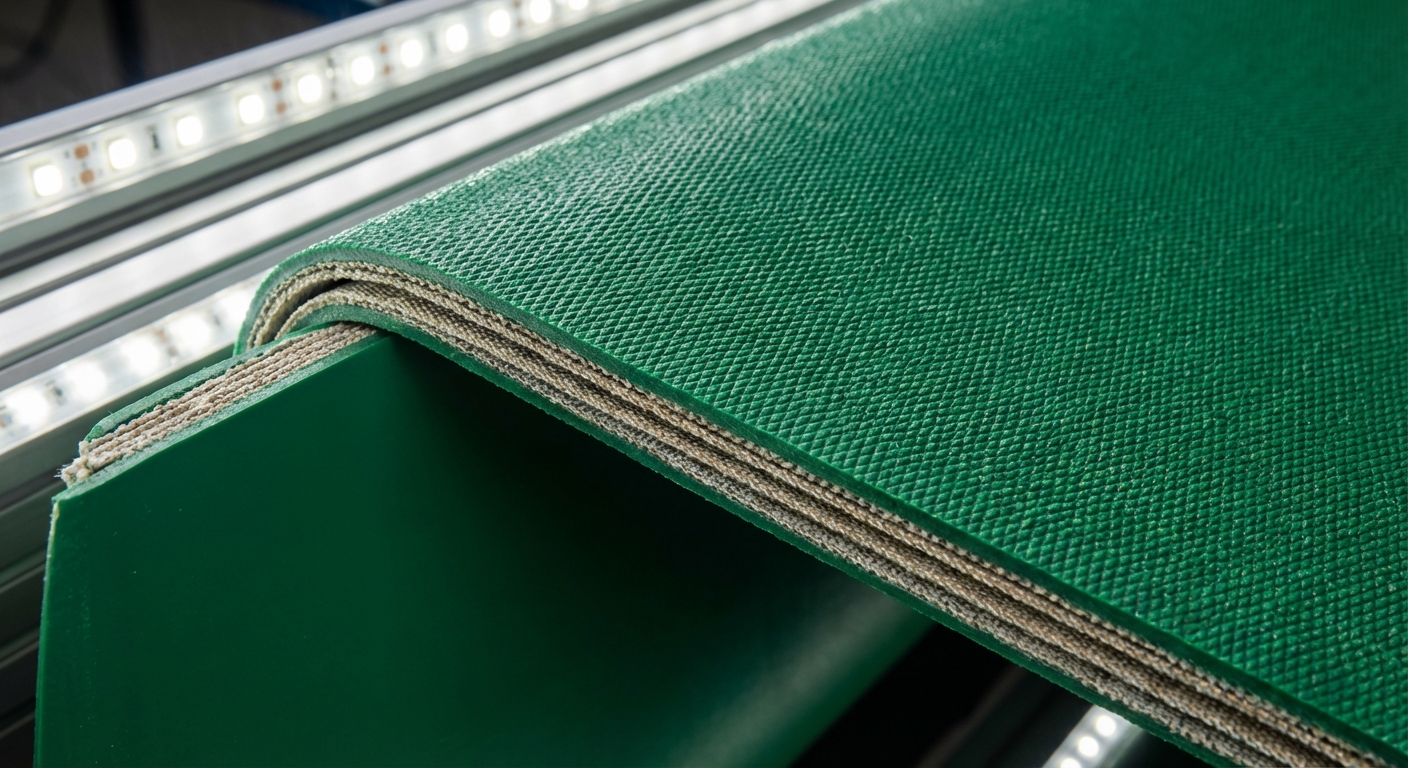
An anti slip rubber conveyor belt provides high-friction transport for stable material handling, reducing product damage, preventing jams, and improving safety in automated systems.
What is an anti slip rubber conveyor belt?
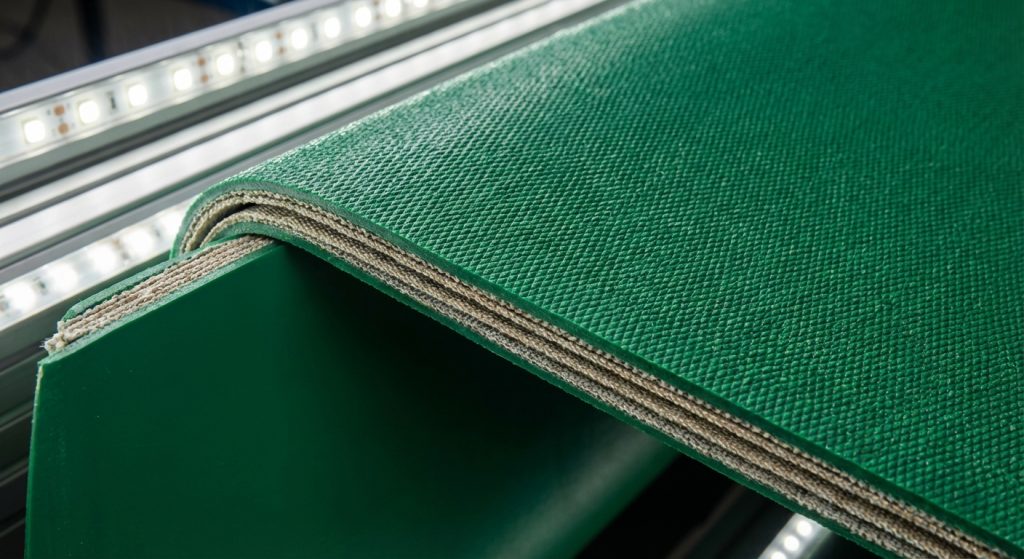
An anti slip rubber conveyor belt is a specialized material handling solution featuring a synthetic PVC cover bonded to a high-strength fabric core to provide superior grip. These belts are specifically designed with mechanical textures on the top surface to increase the coefficient of friction. You will find them essential in environments where items are prone to sliding due to smooth packaging or steep inclines.
But that’s not all.
This belt construction offers unique advantages over standard flat surfaces. By combining the flexibility of fabric with the resilience of PVC, you get a durable product that maintains its shape.
- Integrated multi-ply fabric core for high tensile strength.
- Patterned PVC top cover for maximum product stability.
- Wear-resistant compounds designed for 24/7 industrial use.
- Chemical resistance suitable for diverse manufacturing environments.
Here is why you need a summary:
Understanding the basic definition helps you select the right grade for your specific facility needs. Different industries require varying thicknesses and core materials to handle different load capacities effectively.
| Feature | Description | Benefit | |
|---|---|---|---|
| Core Material | High-strength fabric | Prevents belt stretching | |
| Top Coating | Patterned PVC | Increases surface friction | |
| Flexibility | High longitudinal flex | Fits small pulley diameters |
Analysis Guide: When evaluating these belts, prioritize the ratio of top-cover thickness to fabric plies. A thicker PVC cover generally provides a longer lifespan for the anti-slip pattern under heavy use.
Key Takeaway: An anti-slip belt is your primary defense against product displacement, providing a stable foundation for complex conveyor paths.
How does an anti slip rubber conveyor belt work?
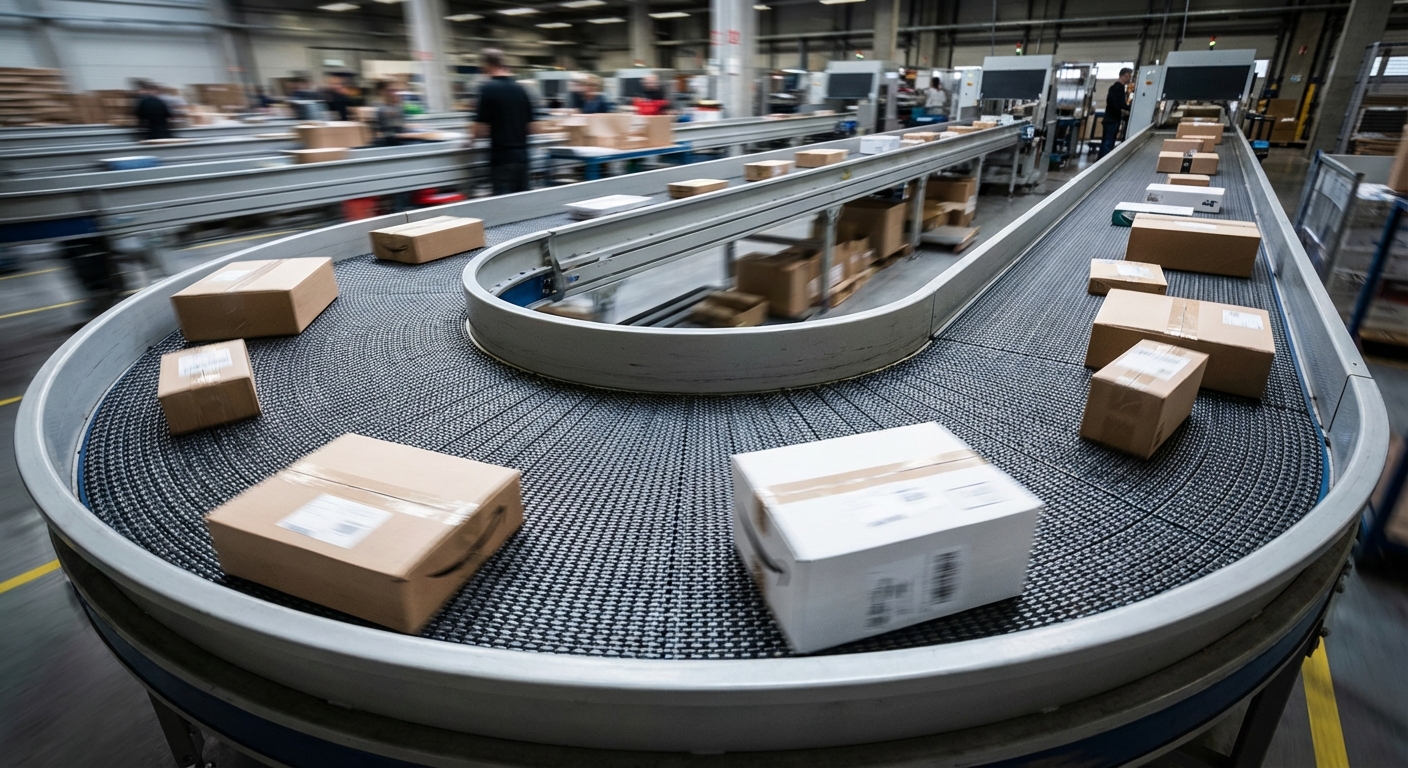
An anti slip rubber conveyor belt works by using mechanical friction and precision-molded surface patterns to “bite” into the bottom of conveyed objects. This interaction ensures that the gravitational pull on an item is offset by the upward frictional force of the belt’s texture. You can run your lines at higher speeds without fearing that your products will “drift” or misalign during rapid transitions.
How does it maintain stability at high speeds?
Centrifugal forces often cause items to shift when a belt moves around a curve or accelerates. The high friction coefficient of these PVC Conveyor Belts creates a secure bond between the item and the belt surface.
- Mechanical interlocking between the belt pattern and product surface.
- Compression of flexible pattern “fingers” under the weight of the load.
- Absorption of system vibrations that typically destabilize light packages.
- Consistent grip levels across both dry and slightly damp conditions.
Want to see the performance breakdown?
The effectiveness of the working principle is measured by the belt’s ability to hold items during sudden starts and stops. You should look for belts that offer a consistent friction rating across their entire surface area.
| Mechanism | Function | Impact | |
|---|---|---|---|
| Surface Texture | Creates mechanical “grip” | Stops product sliding | |
| High Friction Coeff. | Enhances surface bond | Allows higher belt speeds | |
| Material Softness | Conforms to product base | Increases contact area |
Analysis Guide: Analyze your system’s acceleration rates to determine if you need a standard pattern or a “super-grip” variant. Faster lines typically require deeper textures to maintain load integrity.
Key Takeaway: The mechanical design of the surface patterns transforms simple transport into a high-precision positioning system for your goods.
Which patterns fit an anti slip rubber conveyor belt?
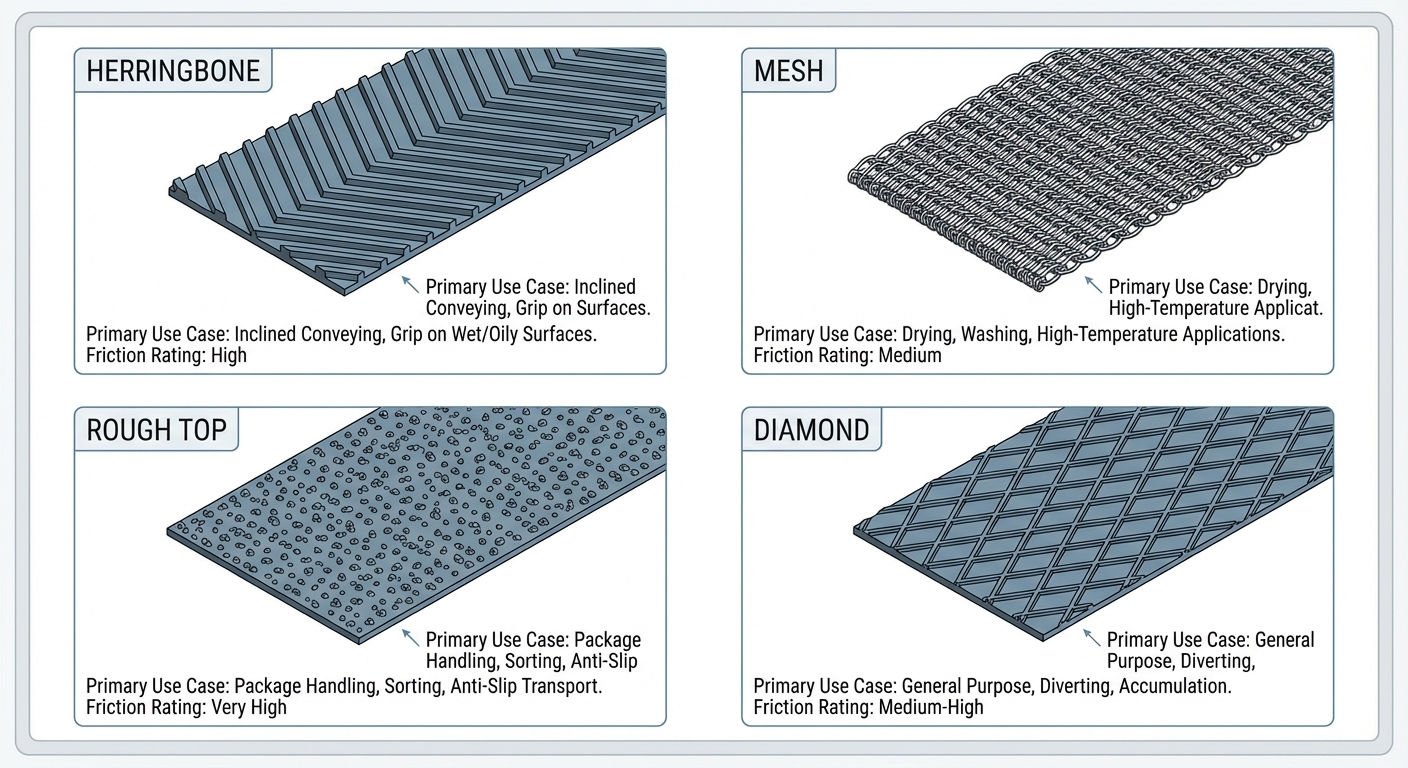
An anti slip rubber conveyor belt can be fitted with several distinct patterns including Herringbone, Mesh, Rough Top, and Diamond textures. Each specific pattern is engineered to solve a different material handling challenge, such as moisture drainage or vertical grip. Selecting the right one is critical to ensuring your products move safely through every stage of production.
Which pattern is best for your specific application?
The choice depends entirely on the nature of the items you are conveying and the environment of your floor. Some patterns are designed to release debris, while others provide a suction-like grip for plastic bags.
- Rough Top: Features thousands of points for maximum grip on bagged goods.
- Herringbone: Ideal for steep inclines where high lateral stability is required.
- Mesh/Diamond: Excellent for small components or environments requiring drainage.
- Longitudinal Groove: Provides stability for cylindrical items or pipes.
But what about specific industrial needs?
You should consider the cleaning requirements and the “release” characteristics of the pattern. Some very aggressive textures might hold onto products too tightly during sorting, leading to discharge issues.
| Pattern Type | Best Use Case | Friction Level | |
|---|---|---|---|
| Rough Top | Cardboard boxes & Bags | Very High | |
| Herringbone | Steep Inclined slopes | High | |
| Diamond | General Purpose sorting | Medium-High |
Analysis Guide: Compare the height of the pattern “profile” to the weight of your lightest product. Light products may “float” on top of deep patterns, actually reducing the effective surface contact.
Key Takeaway: Pattern selection is the most influential factor in your belt’s performance; choose one that matches your product’s base texture.
Where do you use an anti slip rubber conveyor belt?
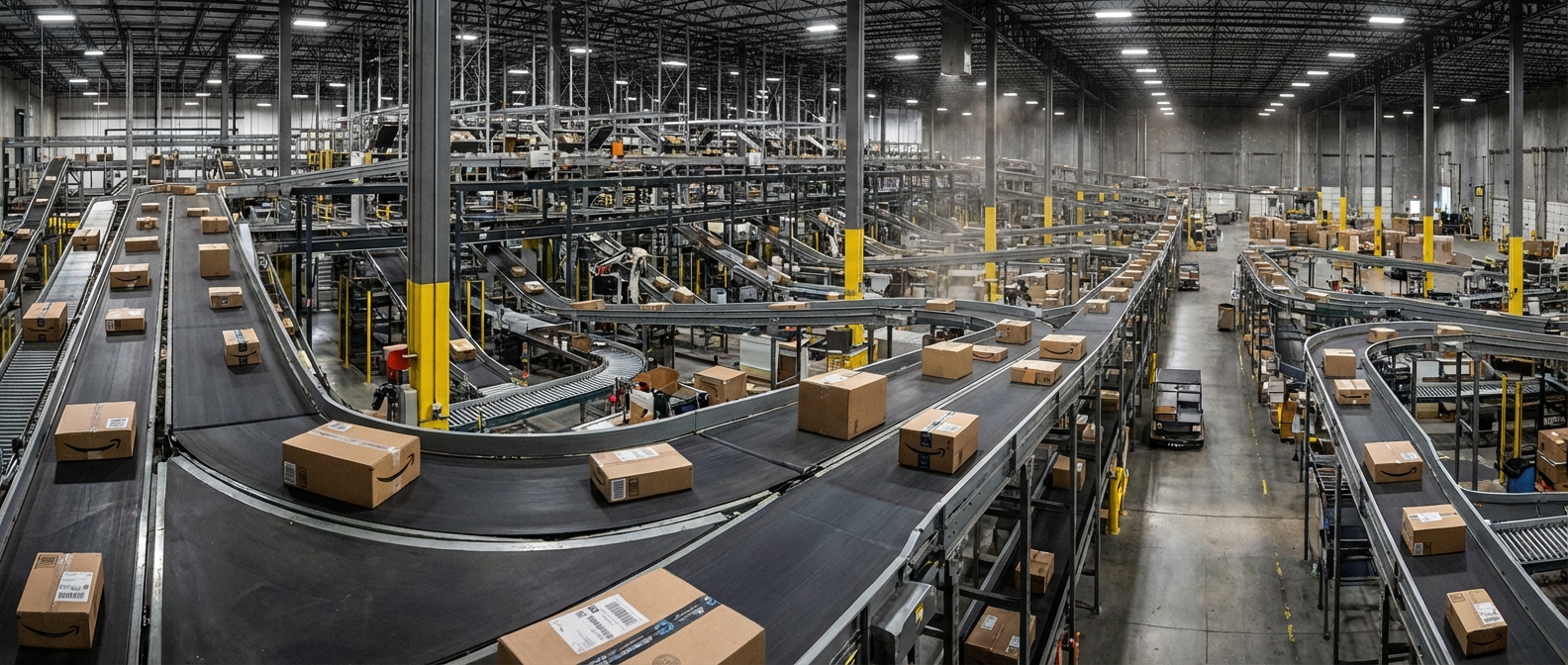
An anti slip rubber conveyor belt is widely used in warehousing, e-commerce distribution centers, packaging lines, and food processing facilities. In these high-volume environments, you cannot afford the downtime associated with product spills or belt jams. These belts provide the reliability needed to keep automated sorting and palletizing robots working at peak efficiency.
Where is the impact felt most?
In modern logistics, diverse packaging materials are moved through complex networks of inclines and declines. These belts ensure that everything from a heavy wooden crate to a thin plastic poly-bag stays exactly where it was placed.
- Distribution centers with multi-tier mezzanine conveyor systems.
- Packaging lines requiring precise alignment for labeling machines.
- Airport baggage handling systems where items vary significantly in size.
- Assembly lines where components must remain stationary during robot interaction.
Are there other niche applications?
You might also find these belts in the pharmaceutical industry or electronics manufacturing where stability is linked to safety. Any industry using Rough Top Belts benefits from reduced waste and higher safety standards.
| Industry | Primary Need | Belt Benefit | |
|---|---|---|---|
| E-commerce | Sorting accuracy | Zero package drift | |
| Packaging | Machine alignment | Precise label placement | |
| Pharmaceuticals | Gentle handling | Prevents vial breakage |
Analysis Guide: Review your facility’s layout for “bottleneck” areas where products tend to bunch up. Installing an anti-slip belt in these zones often resolves flow issues instantly.
Key Takeaway: From logistics to delicate assembly, these belts are the standard for any facility that values throughput and item security.
Why use an anti slip rubber conveyor belt on slopes?
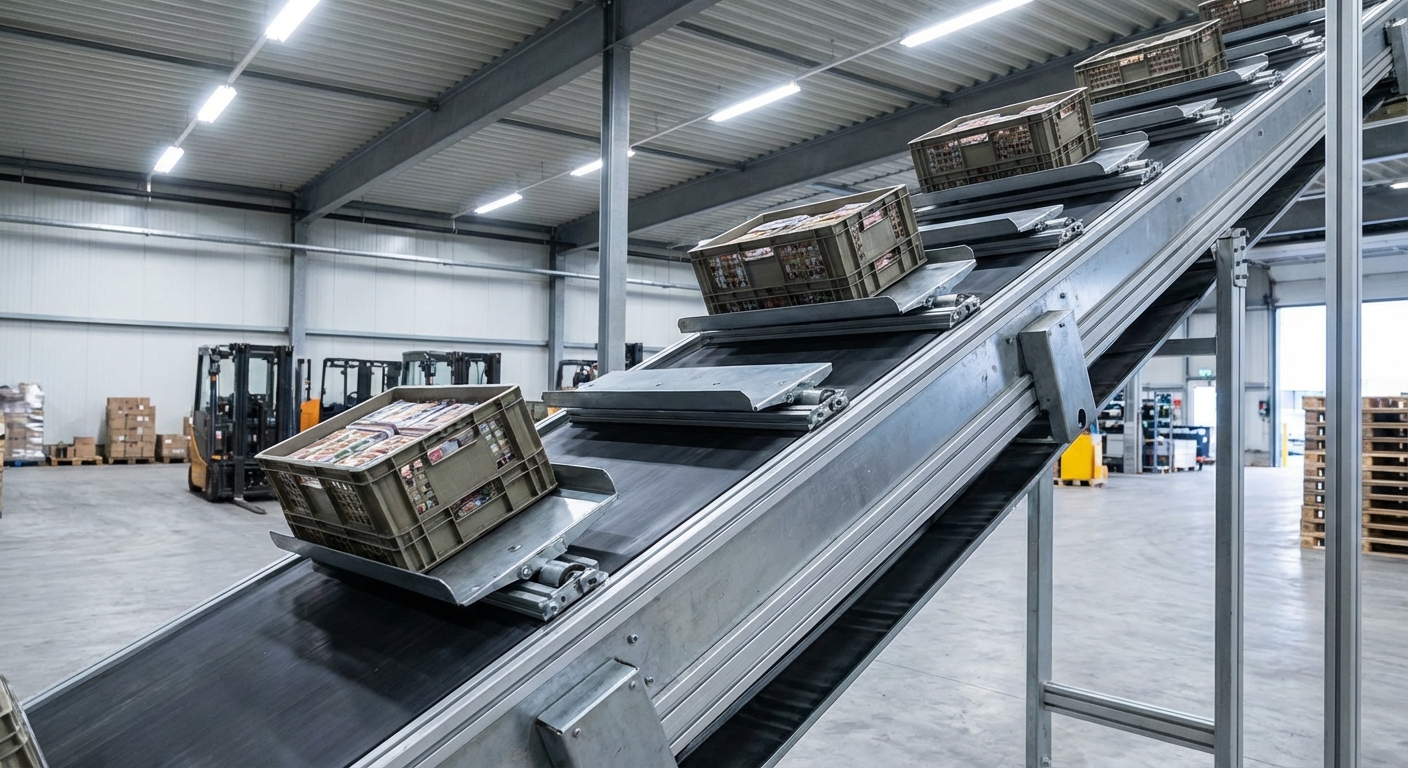
You should use an anti slip rubber conveyor belt on slopes because it allows for efficient material handling at steep angles between 15° and 35°. By increasing the climb angle, you can significantly reduce the total length of your conveyor system and save valuable floor space. Without this specialized grip, items would simply slide backward under the force of gravity, leading to dangerous pile-ups.
Is the steep incline really worth it?
Vertical space is often underutilized in manufacturing plants, but it requires specialized hardware to access. These belts act as a mechanical brake, holding loads securely even if the system stops unexpectedly.
- Reduces the footprint of your conveyor system by increasing slope angles.
- Prevents “back-sliding” of materials during emergency stops or power failures.
- Enables the transport of bulk materials that would otherwise tumble.
- Reduces the need for mechanical “cleats” that can damage fragile goods.
But what about the specific grip requirements?
For the most demanding vertical tasks, you should look toward specialized Chevron Conveyor Belts . These provide integrated profiles that can handle even higher angles for bulk material transport.
| Slope Angle | Belt Type Required | Typical Material | |
|---|---|---|---|
| 0° – 15° | Standard Pattern | Large boxes | |
| 15° – 25° | Rough Top / Herringbone | General packages | |
| 25° – 35° | Deep Profile Anti-Slip | Bagged goods |
Analysis Guide: Calculate the “Angle of Repose” for your products. If your conveyor slope exceeds this angle, an anti-slip belt is not just an option—it is a functional necessity.
Key Takeaway: High-grip belts on inclines allow you to optimize your facility’s 3D space without sacrificing product safety or speed.
How durable is an anti slip rubber conveyor belt?
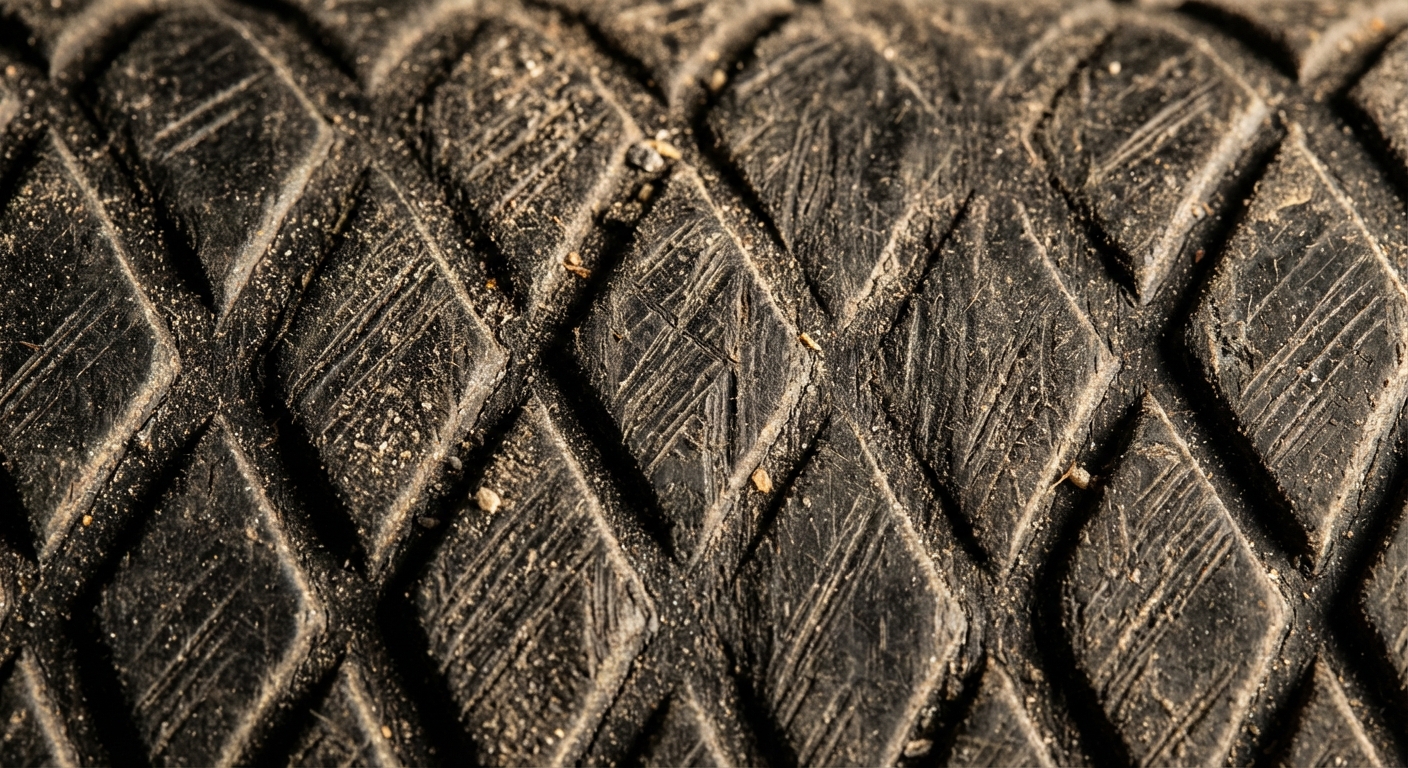
An anti slip rubber conveyor belt is exceptionally durable because it is manufactured from high-grade PVC compounds that resist abrasion, tearing, and surface shearing. Because the textures are designed to create friction, they are prone to wear, so the material must be significantly tougher than standard flat belts. You can expect a service life of several years even in high-frequency sorting environments.
But how does it handle heavy loads?
The durability is not just in the surface, but in the carcass construction. The internal fabric layers ensure the belt does not stretch or lose its tension over time.
- High abrasion resistance ratings (80mm³ – 120mm³) to preserve patterns.
- Tear-resistant fabric core that prevents longitudinal splitting.
- Chemical resistance to oils and fats that can soften lower-quality belts.
- UV stability for outdoor loading docks or high-sunlight warehouse zones.
Want to know the wear indicators?
You should regularly inspect the “peak” of your belt’s pattern. Once the texture wears down to the base level, the friction coefficient drops significantly, and it is time for a replacement.
| Factor | Metric | Durability Level | |
|---|---|---|---|
| Abrasion Loss | 80 – 120 mm³ | High resistance | |
| Tear Strength | 200 – 350 N/mm | Heavy duty | |
| Temperature | -10°C to +70°C | Wide operating range |
Analysis Guide: Monitor the frequency of belt tension adjustments. A high-quality belt should require minimal retensioning, indicating a stable and durable internal fabric structure.
Key Takeaway: Investing in high-durability PVC ensures that your anti-slip solution remains effective for the long haul, reducing your total cost of ownership.
How to customize an anti slip rubber conveyor belt?
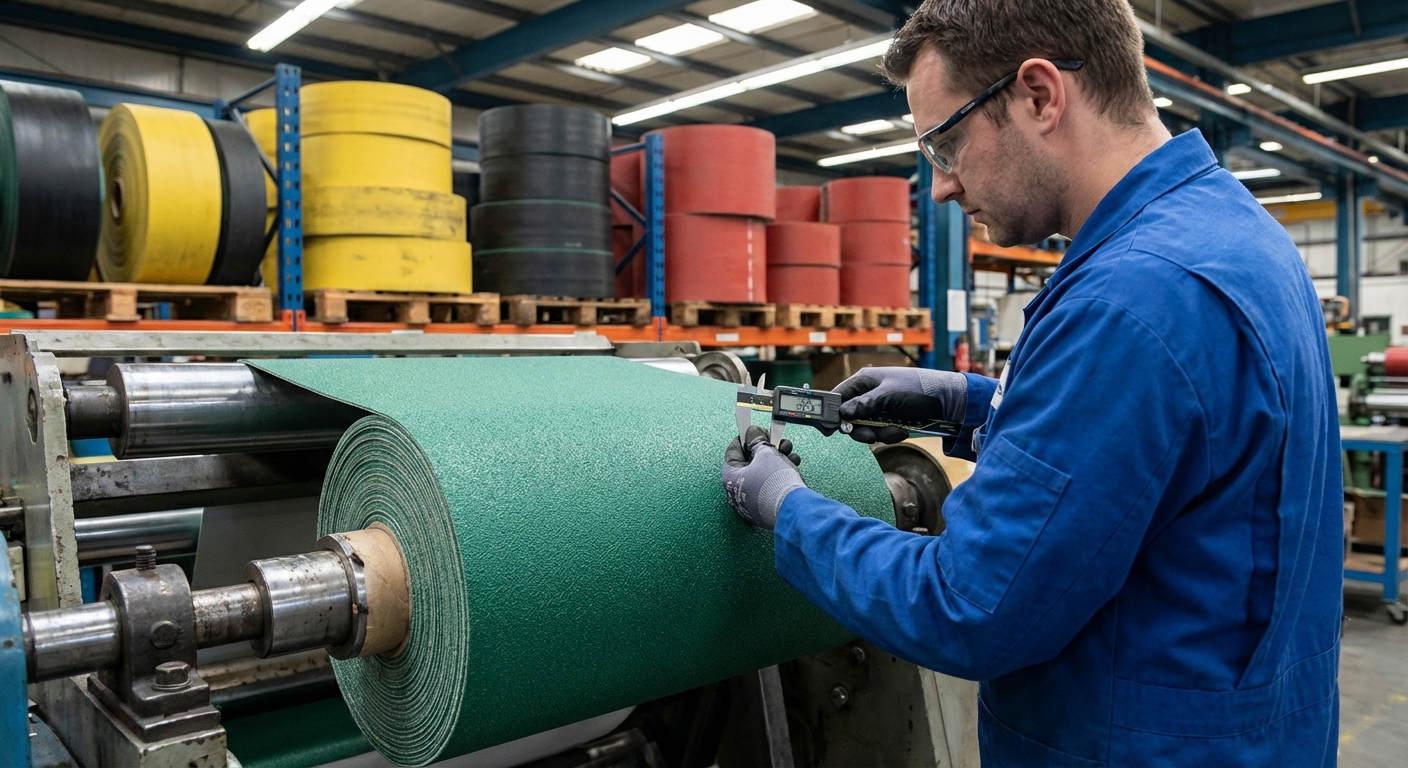
You can customize an anti slip rubber conveyor belt by selecting the exact width, thickness, color, and pattern profile that matches your existing machinery. Customization ensures that the belt fits perfectly onto your rollers without excess friction or tracking issues. You also have the option to include anti-static treatments or food-grade coatings depending on your regulatory requirements.
But that’s not all.
You can specify the number of fabric plies to match the weight of your materials. Heavier industrial loads require a multi-ply carcass to prevent sagging between conveyor rollers.
- Width: Available in custom cuts to match your specific frame dimensions.
- Thickness: Ranges from 2.0mm for light duty to 5.0mm for heavy loads.
- Color: Green for logistics, White for food-grade, or Black for heavy industry.
- Treatments: Anti-static, oil-resistant, or flame-retardant options.
Ready to define your specs?
Consult with engineers to ensure your pulley diameters are compatible with your chosen thickness. A belt that is too thick for its rollers will suffer from premature delamination and cracking.
| Custom Option | Range/Types | Primary Application | |
|---|---|---|---|
| Thickness | 2.0mm – 5.0mm | Load-dependent | |
| Color | White / Green / Black | Industry-specific | |
| Coating | Anti-static / Oil-Res. | Environmental safety |
Analysis Guide: Analyze the “wrap angle” of your belt around your drive pulley. Customizing the belt thickness can help optimize power transmission and reduce motor strain.
Key Takeaway: Customization turns a generic belt into a precision-engineered tool that fits your specific industrial workflow perfectly.
What are the anti slip rubber conveyor belt specs?
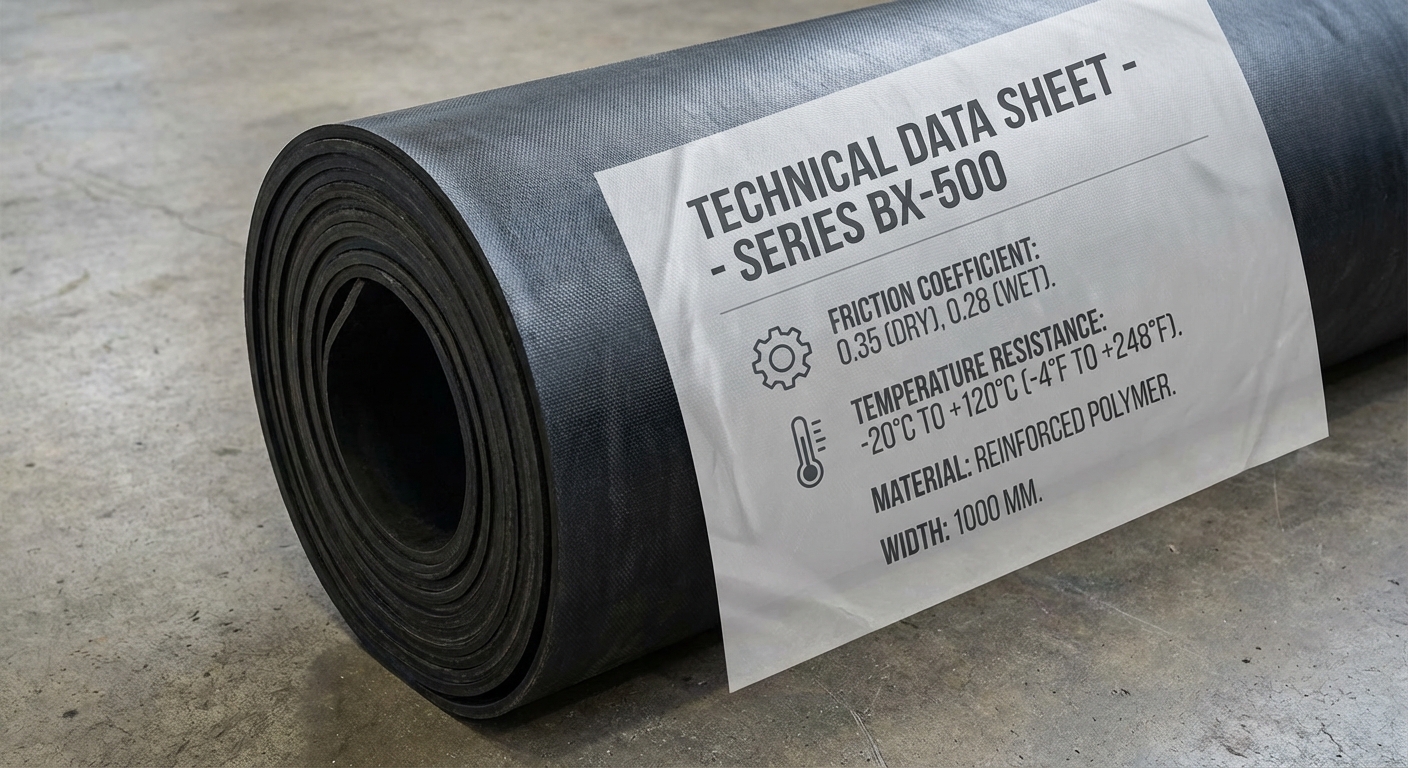
The technical specs of an anti slip rubber conveyor belt include a friction coefficient between 0.6 and 0.8 and a tear strength of 200N/mm to 350N/mm. These numbers represent the belt’s ability to hold a load and resist the mechanical stresses of high-speed operation. You must verify these parameters against your system’s motor power and incline angles to ensure a safe installation.
How do you read these numbers?
The coefficient of friction is the most important spec for stability. A rating of 0.8 means the belt provides an exceptionally high grip, suitable for almost vertical transport of cardboard.
- Total Thickness: Measures the base belt and the pattern height.
- Friction Coefficient: Indicates the level of “grip” against products.
- Operating Temp: Defines the environmental limits for the PVC material.
- Weight: Essential for calculating motor load and support structure capacity.
Here is the data breakdown:
You should keep a record of these specs for maintenance and future ordering. Using the same technical profile ensures consistent performance when you replace worn sections of your line.
| Spec Parameter | Standard Range | Significance | |
|---|---|---|---|
| Friction Coeff. | 0.6 – 0.8 | Grip performance | |
| Max Speed | 1.5 – 3.5 m/s | Production capacity | |
| Surface Type | Patterned | Application focus |
Analysis Guide: Cross-reference the “Max Inclination” spec with your facility’s blueprints. Operating a belt at an angle steeper than its rated spec will lead to rapid product sliding.
Key Takeaway: Understanding technical specs allows you to push your production lines to their safe limits while maintaining total control over your goods.
Is the anti slip rubber conveyor belt safe for food?
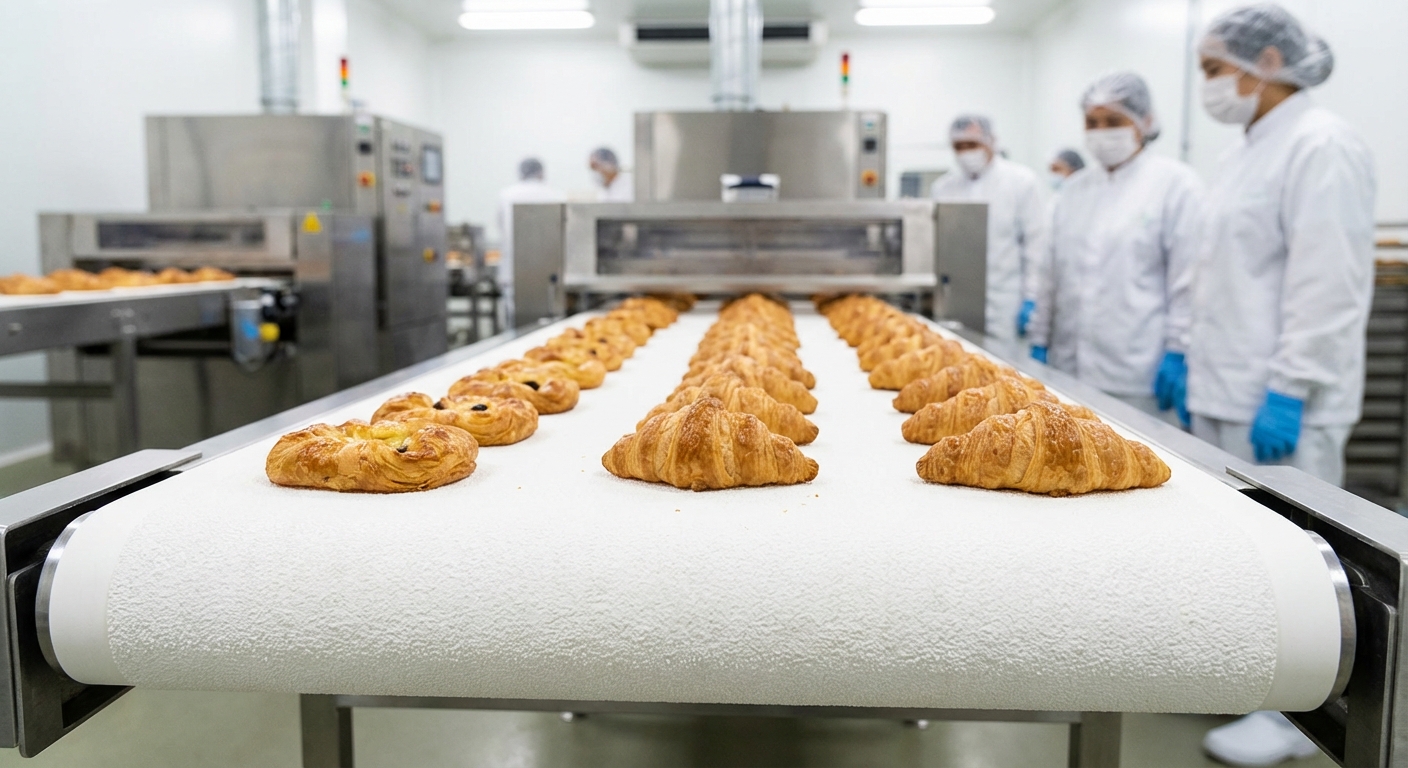
Yes, the anti slip rubber conveyor belt is safe for food processing when manufactured with FDA-compliant white PVC materials. In environments like bakeries or meat processing, surfaces often become slick with fats, water, or oils. You need the anti-slip texture to move individual items like pastries or raw cuts up inclines to the next stage of processing without them sliding or grouping together.
But how does it handle hygiene?
Food-grade belts are designed to be non-porous to prevent bacterial growth. The patterns are engineered to shed moisture and resist the accumulation of food particles in the grooves.
- FDA and EU compliant materials for direct food contact.
- Oil and grease resistant compounds to prevent material degradation.
- Easy-to-clean patterns that stand up to high-pressure washdowns.
- Anti-microbial treatments available for sensitive dairy or meat lines.
What is the best food-grade choice?
For the highest level of safety, choose a White Conveyor Belt with a smooth-profile anti-slip texture. This offers the best balance between grip and cleanability in sterile environments.
| Food Type | Challenge | Solution | |
|---|---|---|---|
| Pastries | Sugar/Oil slippage | Fine diamond pattern | |
| Raw Meat | Moisture/Blood | Herringbone drainage | |
| Fruits | Rolling/Bruising | Soft rough top |
Analysis Guide: Analyze your cleaning chemicals. Ensure your chosen food-grade PVC is compatible with your sanitization agents to prevent the belt surface from becoming brittle over time.
Key Takeaway: Anti-slip food belts are essential for maintaining product separation and orientation in high-speed, hygienic production lines.
How to clean an anti slip rubber conveyor belt?
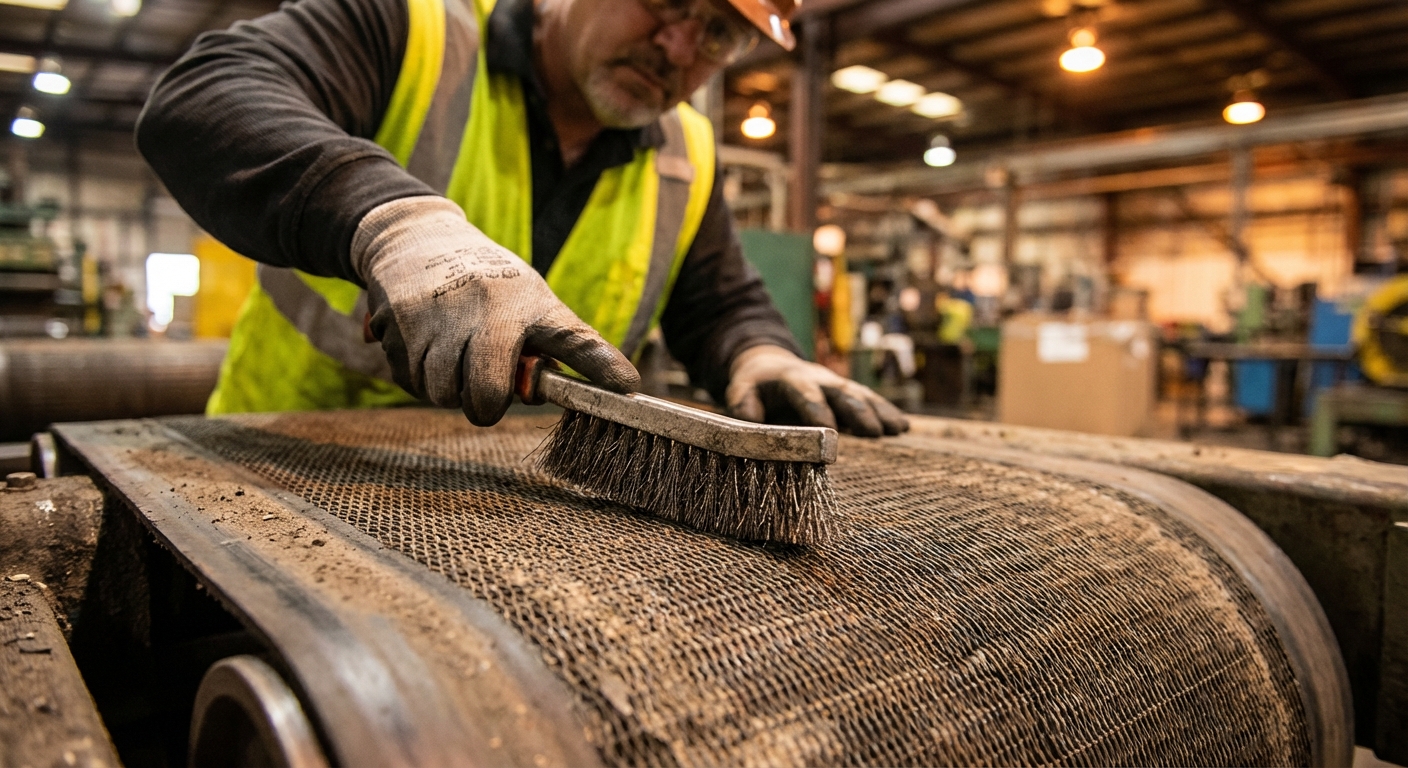
Cleaning an anti slip rubber conveyor belt requires the use of soft-bristle brushes and pressurized air or water to remove debris trapped within the surface patterns. Because these belts are textured, dust and small particles can settle in the “valleys” of the grip, reducing the effective friction coefficient over time. You should establish a regular cleaning schedule to ensure the belt maintains its high performance throughout its lifespan.
How often should you clean it?
The frequency depends on your environment. A dusty warehouse might require a daily air-blast, while a cleanroom electronics line might only need a weekly wipe-down with a damp cloth.
- Use soft-bristle industrial brushes to reach into deep patterns.
- Apply mild detergents for oil or grease removal from the PVC surface.
- Avoid abrasive scrapers that can dull or damage the anti-slip texture.
- Ensure the belt is completely dry before restarting high-incline loads.
Here is a maintenance checklist:
You should also check for any pattern wear during the cleaning process. If you are operating in a coal or mining environment, ensure your flame retardant conveyor belt properties are not compromised by chemical cleaners.
| Step | Action | Frequency | |
|---|---|---|---|
| Surface Brush | Remove loose debris | Daily | |
| Deep Wash | Degrease pattern | Weekly | |
| Visual Check | Inspect pattern wear | Monthly |
Analysis Guide: Observe the “grip efficiency” after cleaning. If the belt remains slippery even when clean, the pattern has likely reached its wear limit and requires replacement.
Key Takeaway: Proactive maintenance keeps the friction levels high and extends the life of your investment, keeping your lines moving smoothly.
Anti-slip Belt Frequently Asked Questions
Can I use a PVC anti-slip belt for outdoor mining operations?No, it is generally not recommended. For heavy-duty mining, you should use rubber-based belts with deeper profiles, though PVC variants can work in light-duty sheltered aggregate handling.
What’s the best way to prevent the belt from mistracking?The best method is ensuring your rollers are perfectly aligned and using a belt with high-quality fabric plies that provide longitudinal stability.
Can I install these belts on my existing conveyor frame?Yes, provided your pulley diameters and motor torque are compatible with the thickness and weight of the new anti-slip belt.
What is the maximum slope angle for bagged goods?Usually, you can safely handle bagged materials at angles up to 35 degrees with a high-quality rough top pattern.
How do I know if I need an anti-static treatment?If you are moving electronics or operating in an environment with combustible dust, anti-static properties are a non-negotiable safety requirement.
Implementing a professional anti-slip solution is the fastest way to reclaim lost productivity and ensure the safety of your goods. Whether you are upgrading a logistics hub or designing a food-grade line, our engineers are ready to assist you. Contact us today for a customized technical solution and quote within 24 hours.