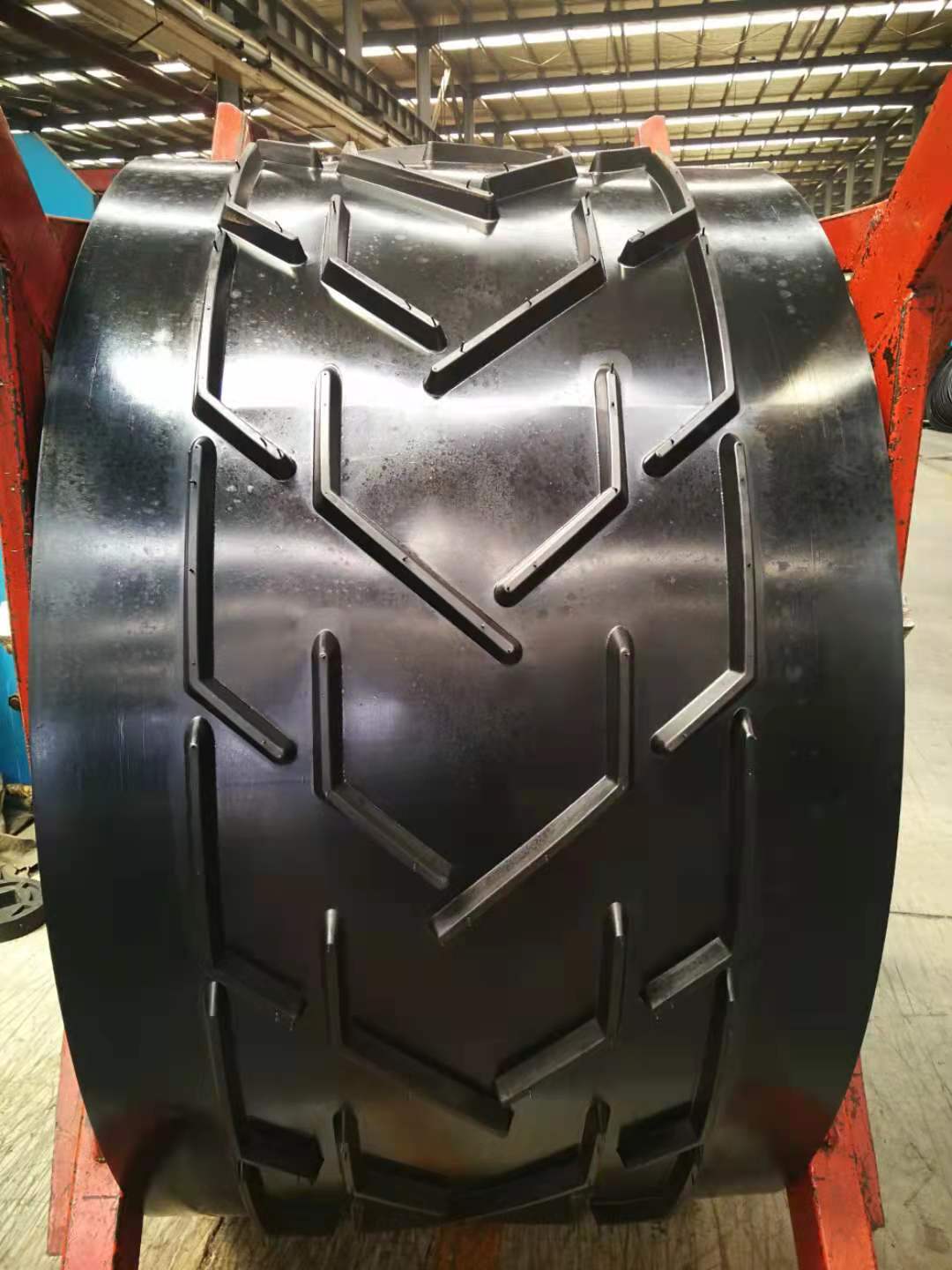
A chevron rubber conveyor belt is a high-performance conveying solution specifically designed for transporting bulk materials on steep inclines without rollback or spillage. Featuring molded chevron patterns and high-grip surface profiles, these conveyor belts securely move aggregates, powders, wet mixtures, and plaster materials while maintaining stable conveying efficiency. Unlike standard flat belts that struggle with material slippage and excessive wear, a chevron rubber conveyor belt improves throughput, reduces maintenance costs, and enhances operational reliability in demanding industrial environments. Widely used in mining, construction, cement, and bulk material handling industries, these belts provide durable, long-lasting performance for high-angle conveying systems.
Why Choose a Chevron Rubber Conveyor Belt?

Choosing a chevron rubber conveyor belt is essential for processing plants that must transport loose bulk materials up steep angles of inclination exceeding 22 degrees. These belts utilize integrated molded cleats that prevent sliding and lock materials safely in place during transport. By choosing a profiled system, you immediately reduce material loss and minimize mechanical wear. Think of it as a critical safeguard for your material flow efficiency.
How Do Profiled Belts Stop Material Slippage?
Flat belts cannot safely transport loose materials at angles steeper than 15 to 22 degrees without causing rollback. Think about it: gravity naturally pulls dry powders, plaster mixes, and aggregates downward once the incline increases.
The integrated cleats on a chevron pattern belt act as physical barriers that trap the materials in pockets. This pocketing action allows you to safely increase your system’s conveying angle. Here is why:
- It creates localized barriers that support the bulk load against gravity.
- It distributes material weight evenly across the belt width.
- It increases loading capacity by preventing sliding.
What Are the Core Operational Benefits?
Using these profiled systems drastically lowers cleanup costs and manual labor requirements around your conveyor structures. Let me explain: when materials stay on the belt, they do not spill onto structural frames or roller assemblies.
Key Takeaway: Investing in a profiled belt design maximizes your daily material throughput while cutting down on clean-up labor. This design ensures that materials reach their destination quickly and without waste.
| Incline Type | Maximum Smooth Belt Angle | Maximum Chevron Belt Angle | |
|---|---|---|---|
| Slightly Rolling | 15° | 30° | |
| Sticky / Wet | 22° | 40° | |
| Packaged Goods | 25° | 35° |
This data highlights why selecting correct profiles minimizes conveyor wear over long-term operations.
How Does a Chevron Rubber Conveyor Belt Work?

A chevron rubber conveyor belt works by mechanically trapping bulk materials within its raised, molded profiles to counteract gravity on steep inclines. The vulcanized cleats form pocket-like barriers that hold aggregate, sand, or plaster mixtures in place. As the belt moves, these profiles support the weight of the load and prevent material rollback. This physical design ensures continuous material transit at steep operational angles.
How Do Cleats Prevent Material Rollback?
When bulk material is fed onto the moving belt, the material settles between the raised rubber cleats. But that is not all, as the angle of the conveyor rises, the physical height of the cleat bears the downward force of gravity.
This localized trapping effect prevents the material from gaining downward momentum. The overall result is a highly stable, uniform material flow.
- Cleats divide the continuous load into manageable segments.
- The chevron pattern directs material toward the center.
- The height of the cleat determines the maximum transportable lump size.
What Role Does the Carcass Play?
Underneath the profiled rubber cover lies a high-strength polyester/nylon (EP) textile carcass that provides structural stability. Here is why: this multi-ply fabric core offers excellent tensile strength and minimal elongation under load.
Key Takeaway: The high-tensile fabric carcass works in tandem with the molded cleats to maintain tension over long conveyor distances. This robust combination prevents stretching and ensures stable high-angle operation.
| Component | Primary Function | Operational Impact | |
|---|---|---|---|
| Molded Cleats | Prevents material rollback | Eliminates slide-back waste | |
| EP Textile Carcass | Provides tensile strength | Minimizes structural stretching | |
| Top Cover Compound | Resists abrasion and cuts | Extends service lifespan |
This structural analysis demonstrates how fabric carcass strength dictates incline capacity.
What Are Chevron Rubber Conveyor Belt Types?

Several types of chevron rubber conveyor belt configurations exist to handle different material textures, moisture levels, and incline requirements. These profiles include Open-V, Closed-V, Multi-V, and heavy-duty Bull Horn patterns. Selecting the correct type of profile ensures optimal load grip and efficient discharge at the head pulley. Manufacturers customize these patterns to match specific aggregate and dry bulk industrial processes.
What is the Difference Between Open-V and Closed-V?
The Closed-V pattern is designed primarily for the transportation of dry, fine materials like grain, sand, and fine plaster. Think about it: the continuous profile holds fine materials securely in the center of the belt.
In contrast, the Open-V pattern features gaps at the center or edges of the profile. This specific design is highly beneficial for processing plants.
- It allows water to drain naturally from wet aggregates.
- It prevents sticky materials from clogging the profile.
- It simplifies the cleaning process during return-side travel.
When Should You Use Bull Horn or Multi-V Profiles?
For high-capacity aggregate plants, heavy-duty U-shaped Bull Horn profiles provide superior carrying volumes. But that is not all, as the continuous structural struts on these belts also prevent sagging when crossing return idlers.
Key Takeaway: Choosing specialized patterns like Bull Horn or Multi-V allows your facility to convey high-volume loads safely. This prevents belt sag and maintains uniform material distribution.
| Profile Type | Primary Material Suitability | Best Angle Range | |
|---|---|---|---|
| Closed-V | Dry sand, grains, powder, small rubble | 25° – 35° | |
| Open-V | Wet aggregate, coal, wood chips | 30° – 40° | |
| Bull Horn | Large lumps, heavy quarry materials | 30° – 40° |
This comparison outlines why selecting custom profiles prevents aggregate back-sliding.
When to Use a Chevron Rubber Conveyor Belt?

You should use a chevron rubber conveyor belt whenever your factory or quarry layout requires material to be transported at incline angles exceeding 15 to 22 degrees. Standard flat belts fail in these steep configurations because material begins to slide backward, creating blockages. These cleated belts are ideal for space-constrained plants that must move materials vertically within a compact footprint. Utilizing profiled belts in these scenarios prevents catastrophic aggregate spillage and maintains peak B2B production efficiency.
Is Your Conveyor Angle Too Steep for Flat Belts?
Standard conveyor setups are physically limited by the natural angle of repose of the materials being carried. Let me explain: once your conveyor incline angle crosses 18 degrees, standard flat belts lose their grip.
Transitioning to a profiled cleated design is the most cost-effective way to solve this angle challenge. This avoids the need for massive, expensive horizontal conveyor extensions.
- It allows space-saving steep vertical configurations.
- It minimizes total conveyor footprint in tight plants.
- It reduces the structural steel cost of long conveyor runs.
How Does Material Composition Dictate Belt Choice?
The choice to transition to a profiled belt is heavily dependent on whether your material is dry, wet, or sticky. Think about it: wet sand and plaster mixes slip much faster than dry packages on inclined surfaces.
Key Takeaway: Use profiled belts when your material profile or moisture level causes back-sliding on inclines. This prevents structural aggregate loss and maintains consistent plant operating speeds.
| Material Type | Slip Risk on Flat Belt | Recommended Profile Height | |
|---|---|---|---|
| Wet Sand / Earth | Extreme | 15mm – 25mm | |
| Coarse Gravel | High | 10mm – 15mm | |
| Fine Powders | Medium | 6mm – 10mm |
This technical data shows how matching profile height to material flow risks prevents conveying failures.
Who Needs a Chevron Rubber Conveyor Belt Now?

Quarry operators, cement factories, plaster casting facilities, and agricultural processors urgently need a chevron rubber conveyor belt to optimize their bulk handling layouts. Any business processing granular material on inclined systems can benefit immediately from the superior grip of cleated profiles. This technology is vital for plant managers looking to scale up throughput while reducing material loss. Implementing these belts immediately translates into lower maintenance costs and higher daily profits.
Why Do Plaster Casting Plants Need Profiled Belts?
Plaster casting and cement batching plants handle fine powders that are highly prone to fluidization and rapid back-sliding. Here is why: when dry plaster mixes are conveyed up steep inclines, they behave like liquids and slide easily.
The raised cleats of a profiled belt act as stable bulk containers that prevent this fluid-like sliding. This helps maintain a highly consistent mixing ratio in downstream processes.
- It locks fine plaster and cement powders in place.
- It prevents raw material segregation during transit.
- It ensures a continuous, metered feed to the casting molds.
Do Quarry and Aggregates Operators Benefit?
Mobile crushing plants and quarry operations handle abrasive stones that slip easily on steep incline setups. But that is not all, as these materials can also puncture standard belts when sliding backwards at high speeds.
Key Takeaway: Industrial mineral and sand processors must utilize durable profiled belts to keep heavy, abrasive aggregates moving smoothly. This prevents hazardous blockages and protects valuable crushing equipment.
| Industry Sector | Primary Processing Challenge | Chevron Solution | |
|---|---|---|---|
| Plaster Casting | Powder fluidization and sliding | High-frequency Closed-V pockets | |
| Sand & Rock Quarry | Heavy aggregate rollback | Tough 15mm-25mm wear cleats | |
| Agriculture & Grain | Kernel rolling on steep inclines | Low C5/V6 profile patterns |
This correlation explains why specific industries choose patterned profiles to survive heavy wear.
Where Is a Chevron Rubber Conveyor Belt Used?

A chevron rubber conveyor belt is widely used across open-cast mines, aggregate quarries, mobile recycling systems, and plaster processing facilities worldwide. These belts perform exceptionally well in heavy-duty industrial zones where space constraints require steep incline materials handling. You will also find them in agricultural storage hubs, wood chip plants, and bulk cargo port terminals. Their versatile design makes them the go-to solution for high-angle industrial transport across diverse B2B sectors.
Are Profiled Belts Critical for Mobile Crushers?
Mobile screening and crushing machines operate within highly compact structural frameworks that demand steep discharge conveyor angles. Think about it: a short conveyor must lift crushed stone quickly into storage bins or haul trucks.
Without a high-grip profiled belt, these mobile units would be physically unable to discharge materials efficiently. The integrated cleats make these space-saving designs possible.
- They enable compact, towable crushing machine designs.
- They allow rapid material discharge within limited space.
- They resist the high impacts of newly crushed rock.
How Do Port Terminals and Silos Use Them?
Grain silos and port terminals use high-speed inclined belts to load bulk cargo onto ships or storage towers. Let me explain: these high-throughput environments require belts that can handle immense volumes without spillage.
Key Takeaway: Bulk shipping and storage facilities must deploy high-angle profiled belts to optimize loading speeds. This keeps transit operations on schedule and minimizes aggregate waste.
| Application Site | Typical Incline Angle | Key Material Handled | |
|---|---|---|---|
| Mobile Screening | 30° to 35° | Crushed stone, concrete debris | |
| Port Bulk Loader | 25° to 30° | Grain, fertilizers, coal | |
| Plaster Plant | 22° to 28° | Raw gypsum, limestone powder |
This data maps the geographic and mechanical scope of modern profiled belt applications.
Can a Chevron Rubber Conveyor Belt Stop Slips?

Yes, a chevron rubber conveyor belt is specifically engineered to eliminate material slippage and prevent structural rollback on steep angles. The molded rubber cleats provide a high-friction mechanical grip that physically locks loose bulk items onto the belt surface. This structural profiling ensures that sand, plaster, and gravel move in perfect sync with the belt carcass. Stopping slippage is the single best way to optimize your facility’s energy efficiency.
How Does Mechanical Grip Replace Simple Friction?
Flat rubber belts rely entirely on surface friction to hold materials, which quickly fails when moisture or fine dust is present. But that is not all, as fine particles create a lubricating layer that causes materials to slide back rapidly.
The raised chevron cleats replace simple surface friction with physical structural containment. This mechanical holding force remains highly effective even under wet quarry conditions.
- Cleats lock aggregates into stable physical compartments.
- They break the momentum of potential sliding material.
- They maintain grip in wet, dusty, or muddy conditions.
Does Eliminating Slips Reduce Energy Costs?
When material slides backward on an active conveyor, the motor continues to draw high electrical power without delivering payload. Here is why: the system wastes energy re-conveying the same material repeatedly.
Key Takeaway: Preventing slip-back directly reduces the load on your conveyor drive motors, leading to significant electrical savings. This helps protect your mechanical drives from premature wear.
| Slip Prevention Level | Belt Surface Profile | Energy Loss Percentage | |
|---|---|---|---|
| Poor (High Loss) | Smooth Flat Rubber | 15% – 25% (on inclines) | |
| Excellent (Low Loss) | Low Chevron (6mm) | 2% – 5% | |
| Maximum (No Loss) | High Chevron (25mm) | Under 1% |
This comparison underscores why maximizing grip directly decreases motor stress.
How to Care for a Chevron Rubber Conveyor Belt?

Caring for a chevron rubber conveyor belt requires regular cleaning, accurate tracking adjustments, and timely structural inspections of the return idlers. Because the belt surface is profiled, traditional flat belt scrapers cannot be used to remove carryback material. Instead, operators must utilize specialized rotary brush cleaners to keep the cleat pockets free from debris. Proper maintenance ensures a long belt lifespan and prevents expensive unexpected downtime.
How Do You Clean Profiled Belts Safely?
Standard blade scrapers will catch on the raised cleats of a profiled belt and cause severe structural tearing. Think about it: a rigid metal blade running against molded rubber profiles is a recipe for disaster.
To prevent carryback without damaging the cleats, plants must install specialized motorized brush cleaners. These flexible rotary brushes sweep material out of the chevron pockets easily.
- They use flexible nylon bristles that adapt to cleat shapes.
- They prevent wet material from hardening inside the V-grooves.
- They reduce abrasive wear on return-side idler rollers.
Why Is Return Side Tracking Critical?
Profiled belts must pass over return idlers that can cause uneven wear if the belt is misaligned. Let me explain: if the belt drifts to one side, the raised cleats will rub against the conveyor frame and tear.
Key Takeaway: Regularly check return roller clearances and install self-aligning tracking systems to protect the raised cleats. This simple preventive step prevents catastrophic edge wear.
| Maintenance Area | Cleaning Method | Recommended Frequency | |
|---|---|---|---|
| Pocket Cleaning | Rotary motorized brush | Daily (continuous) | |
| Tracking Alignment | Visual check & sensor verify | Weekly | |
| Splice Inspection | Physical weld wear assessment | Monthly |
This routine schedule demonstrates how systematic cleaning protects against premature belt replacement.
What Is Chevron Rubber Conveyor Belt Lifespan?

The lifespan of a chevron rubber conveyor belt typically ranges from three to over seven years, depending on the abrasiveness of the material and operational care. High-quality belts are manufactured with homogeneous, co-vulcanized cleats that will not peel or detach under heavy loads. Selecting a robust rubber cover compound that matches your material’s temperature and chemical profile is critical to maximizing durability. Investing in premium manufacturing always yields a lower total cost of ownership.
What Causes Cleat Detachment and Peel?
Low-grade chevron belts are often made by cold-bonding cleats onto a flat belt after vulcanization. Here is why: these bonded seams quickly fail under the shear stress of transporting heavy aggregate loads.
To avoid premature failure, always select belts where the profiles are molded and vulcanized simultaneously with the base rubber. This guarantees a single, indestructible molecular structure.
- It eliminates glue line failure points.
- It resists high shear forces at the head pulley.
- It prevents water from undermining the profile bond.
How Do Cover Compounds Affect Durability?
Abrasive sand, sharp limestone, and plaster compounds can rapidly erode the rubber cover if the compound grade is weak. But that is not all, as oil-blended or high-temperature materials will swell and soften standard rubber.
Key Takeaway: Always match your belt’s cover grade to your material’s physical and chemical properties. Choosing abrasion-resistant or heat-resistant compounds ensures your belt reaches its full service potential.
| Cover Grade Type | Core Performance Target | Expected Service Life | |
|---|---|---|---|
| High Abrasion (AS-N) | Sharp aggregates, quarries, sand | 5 – 7 Years | |
| Heat Resistant (HR) | Hot cement clinker, chemicals | 3 – 5 Years | |
| Oil Resistant (MOR) | Nitrile-blend, chemical processing | 4 – 6 Years |
This life expectancy chart outlines how chemical resistance keeps the belt carcass protected.
How to Buy a Chevron Rubber Conveyor Belt?

To buy a chevron rubber conveyor belt, you must accurately calculate your system’s incline angle, specify the required belt width, and define the average particle size of your bulk material. Purchasing directly from a self-owned manufacturer eliminates middleman markups and allows for precise customization of cover compounds. Experienced engineering teams can help you select the ideal cleat height and pocket width to maximize conveying volumes. This direct collaboration ensures you receive a high-performance, cost-effective bulk handling solution.
What Specifications Must You Provide?
When requesting a quote, you need to provide more than just the physical length and width of your conveyor frame. Think about it: the material’s lump size and moisture content dictate the exact profile pattern you need.
Providing these key details up front allows manufacturers to configure a belt that will not suffer from material spillage. Ensure you have these parameters ready for your supplier:
- Exact conveyor angle of inclination.
- Material density and peak hourly throughput.
- Pulley diameter and return roller clearances.
Why Buy Direct from the Factory?
Buying from a direct manufacturer like Zhenxing Rubber ensures consistent quality control and saves you up to fifteen to thirty percent. Let me explain: eliminating trading company fees allows you to invest in higher-grade wear compounds.
Key Takeaway: Partnering directly with an established manufacturer guarantees access to specialized engineering advice and reliable product warranties. This ensures that your system operates at peak capacity for years to come.
| Selection Factor | Custom Specification | Operational Benefit | |
|---|---|---|---|
| Incline Angle | Choose 15mm – 25mm profiles | Maximizes high-angle transport | |
| Wet Material | Specify Open-V pattern | Ensures proper drainage | |
| Small Pulley | Select flexible EP fabric plies | Prevents core ply separation |
This systematic checklist helps B2B purchasing managers streamline the customization process.
Conclusion
Achieving seamless bulk material transportation on steep inclines requires moving away from friction-reliant flat belts to robust, structurally engineered profiles. Material rollback, aggregate spillage, and high operational energy costs are serious bottlenecks that slow down your processing lines. At Weifang Zhenxing Rubber, we have been delivering direct-factory solutions since 1983, utilizing our seventy-two specialized chevron molds to customize high-tensile systems. To eliminate material waste and optimize your plant’s throughput, contact us today to work with our expert engineering team on a custom-designed, long-lasting bulk handling solution.
FAQ
Can I use a chevron rubber conveyor belt for both wet and dry materials?
Yes, you can. However, you must choose an Open-V pattern to allow water drainage for wet materials, whereas a Closed-V pattern is ideal for keeping dry powders securely centered.
What’s the best way to clean sticky materials off a profiled belt?
Installing a motorized rotary brush cleaner is the best method. Standard rigid scrapers will catch on the molded cleats and tear them, while flexible nylon bristles safely sweep out the pockets.
How do I know if my conveyor angle requires a profiled belt?
If your incline angle is greater than 15 to 22 degrees, a flat belt will cause material to slide backward. Upgrading to molded profiles becomes absolutely necessary at these steep angles to prevent spillage.
Can I splice a profiled textile belt using mechanical fasteners?
Yes, you can use mechanical fasteners for quick repairs. For long-term operations, however, hot or cold material vulcanization is highly recommended to maintain maximum joint strength.